

Language support for foreign patients in Korea includes professional medical interpreters, multilingual hospital staff, International Patient Centers, translated medical documents, and remote consultation services. These resources help international patients communicate effectively with healthcare providers, improving patient safety, treatment understanding, and overall medical experience.
KoreaMedTour.com
Quick Summary
Language Support for Foreign Patients in Korea helps international patients communicate safely and effectively throughout their healthcare journey in South Korea. Leading hospitals provide professional medical interpreters, multilingual International Patient Centers, translated medical documents, and bilingual coordinators to bridge language barriers during consultations, diagnosis, treatment, hospitalization, and follow-up care. These services improve patient safety, support informed decision-making, and create a smoother, more accessible medical experience for overseas patients seeking treatment in Korea.
Key Advantages:
- Professional medical interpreters for accurate communication during consultations and treatment
- Multilingual International Patient Centers offering personalized support from inquiry to follow-up
- English-speaking doctors and multilingual coordinators at many leading Korean hospitals
- Translation of medical records, imaging reports, prescriptions, discharge summaries, and consent forms
- Clear explanations of diagnoses, treatment options, surgical procedures, medications, and recovery plans
- Assistance with appointment scheduling, hospital registration, insurance inquiries, and billing guidance
- Remote language support through video or telephone interpretation when available
- Improved patient safety by reducing communication errors and ensuring informed consent
- Better coordination between international patients, physicians, nurses, and healthcare staff
- Enhanced continuity of care through multilingual follow-up consultations and post-treatment communication
Common Use Cases:
Medical language support is widely used for international health screenings, cosmetic and plastic surgery, dermatology treatments, orthopedic and spine surgery, cancer care, fertility treatment (IVF), dental implants, ophthalmology procedures including SMILE LASIK and cataract surgery, cardiovascular treatment, rehabilitation programs, regenerative medicine, chronic disease management, pediatric care, second medical opinions, telemedicine follow-up, and comprehensive medical tourism services for foreign patients receiving healthcare in South Korea.
Table of Contents

Language Support for Foreign Patients in Korea
South Korea has become one of Asia’s leading destinations for medical tourism, attracting hundreds of thousands of international patients seeking advanced treatments, cosmetic surgery, cancer care, health screenings, fertility services, orthopedics, and dermatology. While Korean hospitals are internationally recognized for medical excellence, many foreign patients share one common concern before traveling:
“Will I be able to communicate with my doctor?”
The good news is yes. Many Korean hospitals that serve international patients provide professional language support through multilingual coordinators, certified medical interpreters, translated medical documents, and dedicated international patient centers. However, the availability and quality of these services vary depending on the hospital, specialty, and language requested.
This guide explains how language support works in Korea’s healthcare system, what services patients can expect, and how to prepare for a smoother medical journey.
Why Language Support Matters in Medical Care
Healthcare communication involves far more than everyday conversation. Patients must accurately explain symptoms, understand diagnoses, review treatment options, provide informed consent, and follow medication instructions.
Even individuals with conversational English or Korean may struggle with medical terminology.
Professional language assistance helps reduce communication errors that may affect:
- Diagnosis
- Treatment planning
- Surgical consent
- Medication safety
- Follow-up care
- Recovery instructions
Studies published by organizations including the World Health Organization (WHO) and patient safety researchers consistently show that language barriers can increase medical misunderstandings, reduce patient satisfaction, and contribute to preventable healthcare errors.
How Korean Hospitals Support International Patients
Most hospitals that actively treat overseas patients have established International Patient Centers.
These departments coordinate nearly every aspect of a patient’s visit, including:
- Appointment scheduling
- Medical record review
- Language interpretation
- Airport pickup arrangements
- Hotel recommendations
- Payment assistance
- Insurance guidance
- Follow-up consultations
Rather than requiring patients to navigate multiple departments independently, international coordinators serve as a central point of contact throughout treatment.
Languages Commonly Available
Large university hospitals and internationally accredited private hospitals often support multiple languages.
Commonly available languages include:
| Language | Availability |
|---|---|
| English | Widely available |
| Chinese (Mandarin) | Very common |
| Japanese | Common |
| Russian | Available at many major hospitals |
| Arabic | Available by appointment |
| Mongolian | Common in selected hospitals |
| Vietnamese | Increasing availability |
| Thai | Growing availability |
| Indonesian | Available at selected hospitals |
| Spanish | Limited but available through interpreters |
Some hospitals also arrange interpreters for less common languages through external interpretation agencies.
Types of Language Support Available
1. Professional Medical Interpreters
Medical interpreters specialize in healthcare communication rather than general translation.
Their responsibilities include:
- Explaining medical terminology
- Translating physician explanations accurately
- Assisting during examinations
- Supporting surgical consultations
- Helping patients ask questions
- Clarifying informed consent
Professional interpreters understand both medical vocabulary and cultural differences that may influence communication.
2. International Coordinators
International coordinators perform a broader role than interpreters.
They often assist with:
- Medical appointments
- Travel logistics
- Visa documentation
- Cost estimates
- Medical records
- Insurance paperwork
- Follow-up scheduling
Many coordinators speak multiple languages and remain available throughout the patient’s stay.
3. Translated Medical Documents
Many hospitals provide translated versions of:
- Medical reports
- Laboratory results
- Imaging summaries
- Discharge instructions
- Medication guides
- Surgical consent documents
Translation availability depends on the target language and urgency.
4. Telephone and Video Interpretation
When an in-person interpreter is unavailable, hospitals may arrange:
- Video interpretation
- Telephone interpretation
- Remote multilingual consultation support
These services are increasingly used for follow-up appointments after patients return home.
English Support in Korean Hospitals
English is the most widely supported foreign language.
Most internationally focused hospitals have:
- English-speaking physicians
- English-speaking nurses in international clinics
- English websites
- English appointment systems
- English medical coordinators
However, not every department has fluent English-speaking staff.
For complex procedures involving multiple specialists, hospitals often provide interpreters to ensure consistent communication.
Language Support During Different Stages of Treatment
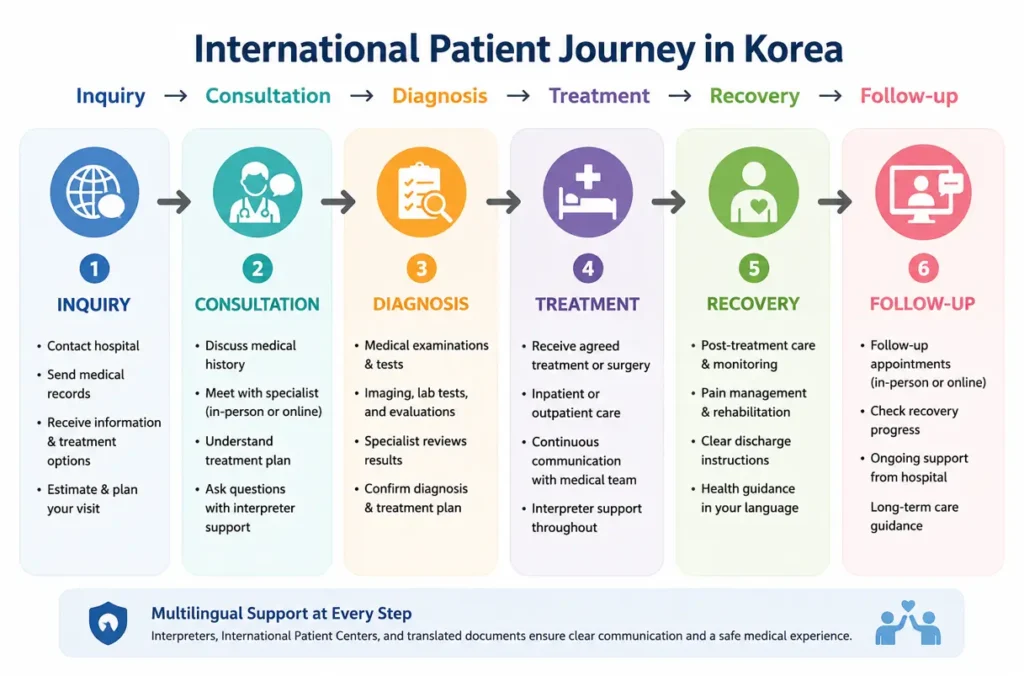
Before Arrival
Patients typically communicate through email or online consultation forms.
Hospitals may request:
- Medical history
- Previous imaging
- Laboratory reports
- Medication lists
- Passport information
International coordinators often translate these documents before physician review.
Initial Consultation
During the first appointment, interpreters assist with:
- Symptom descriptions
- Medical history
- Current medications
- Allergy information
- Treatment goals
- Questions from both physician and patient
Accurate interpretation during this stage is essential because treatment planning begins here.
Diagnostic Testing
Patients may undergo:
- MRI
- CT scans
- Blood tests
- Ultrasound
- Endoscopy
- Physical examinations
Interpreters explain preparation requirements, procedural steps, and expected timelines.
Surgery
Before surgery, patients receive detailed explanations covering:
- Surgical procedure
- Benefits
- Risks
- Alternatives
- Expected recovery
- Potential complications
Professional interpretation helps ensure informed consent is fully understood.
Hospitalization
During admission, language support helps patients understand:
- Nursing instructions
- Medication schedules
- Pain management
- Dietary restrictions
- Mobility guidance
- Daily physician rounds
Some hospitals also provide multilingual patient information booklets.
Discharge and Follow-up
After treatment, patients receive:
- Medication instructions
- Activity restrictions
- Follow-up schedules
- Emergency contact information
- Telemedicine options when available
Many hospitals continue communication through email or secure messaging after patients return home.
Real-World Example
Consider a patient traveling from Australia for spinal surgery.
Without language support, the patient may struggle to understand:
- Surgical options
- Recovery expectations
- Rehabilitation schedule
- Medication adjustments
- Physical therapy instructions
With an experienced interpreter and international coordinator, communication becomes more accurate and organized.
The patient receives translated documents, understands rehabilitation goals, and can continue follow-up consultations remotely after returning home.
This coordinated approach reduces confusion and improves continuity of care.
Medical Interpretation vs. Translation Apps
Many travelers wonder whether smartphone translation apps are sufficient.
Although AI translation technology has improved significantly, healthcare communication still requires caution.
| AI Translation Apps | Professional Medical Interpreter |
|---|---|
| Good for simple conversation | Designed for medical communication |
| May misinterpret terminology | Uses standardized medical vocabulary |
| Limited context | Understands healthcare workflow |
| No responsibility for accuracy | Works directly with healthcare staff |
| Not recommended for consent discussions | Appropriate for informed consent |
Translation apps can be useful for everyday situations but should not replace professional interpretation during medical consultations or procedures.
Common Challenges Foreign Patients Face
Even with language support, patients should prepare for:
Different Medical Culture
Korean consultations may be more time-efficient than those in some Western countries.
Preparing written questions beforehand helps maximize consultation time.
Medical Terminology
Specialized terminology can remain complex even after interpretation.
Patients should ask for clarification whenever needed.
Prescription Instructions
Medication schedules may differ from those in the patient’s home country.
Always review:
- Dosage
- Timing
- Food interactions
- Duration
- Possible side effects
Tips for International Patients
To improve communication:
- Send medical records before arrival.
- Request an interpreter during appointment booking.
- Prepare a written medication list.
- Bring previous imaging on CD or digital format.
- Write down important questions beforehand.
- Confirm whether translated medical reports are available.
- Request written discharge instructions in your preferred language whenever possible.
Choosing a Hospital with Strong Language Support
When comparing hospitals, consider asking:
- Which languages are available?
- Is interpretation free or paid?
- Are interpreters available throughout hospitalization?
- Can medical reports be translated?
- Are follow-up consultations available remotely?
- Does the hospital have an International Patient Center?
- Are emergency interpretation services available?
These questions help patients evaluate communication quality before committing to treatment.
Future Trends in Language Support (2026)
Korean healthcare providers continue investing in technologies that improve communication with international patients.
Emerging developments include:
- AI-assisted medical interpretation
- Real-time multilingual consultation support
- Secure multilingual patient portals
- Automated translation of discharge instructions
- Telemedicine platforms supporting multiple languages
- Voice recognition integrated into electronic medical records
These innovations are expected to complement—not replace—professional medical interpreters, particularly for complex clinical discussions.
FAQ Section

What language support is available for foreign patients in Korea?
Language Support for Foreign Patients in Korea typically includes professional medical interpreters, multilingual hospitals in Korea, translated medical records, and dedicated International Patient Centers. These services help overseas patients communicate accurately with healthcare providers and better understand diagnoses, treatment plans, medications, and follow-up care.
Do Korean hospitals provide English-speaking doctors and medical interpreters?
Yes. Many hospitals offering Language Support for Foreign Patients in Korea have English-speaking doctors and professional medical interpreters. Larger multilingual hospitals in Korea also provide language assistance in Chinese, Japanese, Russian, Arabic, Vietnamese, and other languages depending on patient demand.
How can I request a medical interpreter in Korea before my appointment?
Most hospitals with Language Support for Foreign Patients in Korea allow patients to request a medical interpreter in Korea when scheduling an appointment through their International Patient Center. Booking language assistance in advance helps ensure interpreter availability throughout consultations and treatment.
Are translated medical reports available for international patients in Korea?
Many hospitals that provide Language Support for Foreign Patients in Korea can issue translated medical reports, discharge summaries, imaging results, and treatment records. Availability depends on the hospital, requested language, and document type, so patients should confirm this service before treatment.
Why is professional language support important for medical treatment in Korea?
Professional Language Support for Foreign Patients in Korea reduces communication errors, improves patient safety, and helps patients make informed healthcare decisions. Medical interpreters in Korea and multilingual hospitals in Korea ensure accurate discussions about diagnoses, treatment options, medications, surgery, and recovery instructions, leading to a better overall medical experience.
Final Takeaway
Language support has become an essential component of international healthcare in South Korea. Major hospitals increasingly recognize that effective communication is fundamental to patient safety, informed decision-making, and positive treatment outcomes.
From multilingual coordinators and professional medical interpreters to translated medical documents and remote follow-up services, Korea’s healthcare system has developed comprehensive support for overseas patients. While service availability differs among hospitals, planning ahead and requesting language assistance early can significantly improve the overall medical experience.
For anyone considering treatment in Korea, choosing a provider with a well-established international patient program is one of the most important steps toward ensuring clear communication, safer care, and greater confidence throughout the medical journey.
References
- World Health Organization (WHO). Framework on Integrated People-Centred Health Services. Geneva: World Health Organization. https://www.who.int
- World Health Organization (WHO). Patient Safety. https://www.who.int/teams/integrated-health-services/patient-safety
- Joint Commission International (JCI). International Accreditation Standards for Hospitals. https://www.jointcommissioninternational.org
- Korea Health Industry Development Institute (KHIDI). Medical Korea – Official Information for International Patients. https://www.medicalkorea.or.kr
- Ministry of Health and Welfare (Republic of Korea). Healthcare Policy and International Patient Services. https://www.mohw.go.kr
- Korea Disease Control and Prevention Agency (KDCA). Health Information and Public Health Resources. https://www.kdca.go.kr
- Organisation for Economic Co-operation and Development (OECD). Health at a Glance: OECD Indicators. https://www.oecd.org/health
- Agency for Healthcare Research and Quality (AHRQ). Health Literacy Universal Precautions Toolkit. https://www.ahrq.gov
- The Joint Commission. Advancing Effective Communication, Cultural Competence, and Patient- and Family-Centered Care. https://www.jointcommission.org
- National Academy of Medicine (NAM). Health Literacy and Patient Communication Resources. https://nam.edu

Korea Med Tour – Trusted Blog for Medical Tourism in Korea
Korea Med Tour is a trusted medical tourism content platform providing accurate, research-based healthcare information for international patients considering treatment in Korea.
Our editorial team specializes in global patient guidance, treatment insights, clinic selection, and medical travel planning. All content is developed using verified medical sources and structured editorial review processes to ensure clarity, safety, and reliability.
We are committed to helping international patients make informed and confident medical travel decisions when choosing Korea as their healthcare destination.