


Understanding hospital pricing in Korea means knowing how treatment costs are determined by hospital type, physician expertise, medical complexity, technology, and insurance coverage. Korean hospitals generally provide transparent cost estimates, helping international patients compare medical expenses and make informed healthcare decisions before receiving treatment.
KoreaMedTour.com
Quick Summary
Understanding Hospital Pricing in Korea (2026 Guide) explains how hospitals in South Korea calculate medical costs and why prices vary between healthcare providers. Rather than using a single fixed fee, Korean hospitals determine pricing based on factors such as hospital type, physician expertise, treatment complexity, medical technology, hospitalization, and insurance coverage. With transparent cost estimates, internationally accredited hospitals, and competitive healthcare services, Korea enables international patients to better understand treatment expenses and confidently compare medical options before traveling.
Key Insights
- Hospital pricing in Korea varies according to hospital type, medical specialty, physician experience, treatment complexity, and patient needs.
- Most Korean hospitals provide detailed cost estimates before major procedures, improving pricing transparency.
- Korea’s National Health Insurance (NHI) influences pricing for residents, while international patients generally pay self-pay or international patient rates.
- Cosmetic surgery, dermatology, fertility treatments, and other elective procedures often have separate pricing structures outside NHI coverage.
- Advanced medical technologies, including robotic surgery, AI-assisted diagnostics, digital imaging, and minimally invasive procedures, may affect treatment costs.
- Room selection (shared, private, or VIP) can significantly influence the final hospital bill.
- Hospital invoices commonly include consultation fees, diagnostic tests, physician fees, anesthesia, surgery, hospitalization, medications, and follow-up care.
- International patient centers assist with treatment planning, medical interpretation, appointment scheduling, and cost estimates.
- Comparing hospitals based solely on price may overlook important differences in physician expertise, technology, safety standards, and patient outcomes.
- Korea remains one of Asia’s leading medical tourism destinations by combining transparent pricing, advanced healthcare, and internationally recognized quality standards.
Why Hospital Pricing in Korea Is Transparent
- Written treatment estimates are commonly provided before major procedures.
- Itemized billing helps patients understand individual medical charges.
- Standardized pricing exists for many insured healthcare services.
- Competitive private healthcare encourages price transparency.
- International patient coordinators explain estimated treatment costs before arrival.
- Many hospitals offer bundled pricing for selected medical tourism procedures.
- Patients receive clear explanations of optional services and upgrades.
- Digital medical records improve billing accuracy and communication.
Major Factors That Affect Hospital Pricing in Korea
- Hospital classification (university hospital, general hospital, specialty clinic)
- Physician qualifications and surgical experience
- Medical condition severity and treatment complexity
- Type of surgery or procedure performed
- Diagnostic imaging and laboratory testing requirements
- Medical devices, implants, or premium surgical materials
- Hospital room selection and length of stay
- Anesthesia requirements and operating room time
- Rehabilitation and postoperative care
- Insurance coverage and international patient status
Typical Hospital Cost Components
Although every treatment differs, hospital pricing in Korea commonly includes:
- Initial specialist consultation
- Diagnostic imaging (MRI, CT, X-ray, Ultrasound)
- Laboratory testing
- Procedure or surgery fees
- Surgeon and physician fees
- Anesthesia services
- Operating room charges
- Hospital accommodation
- Medications during hospitalization
- Medical implants or devices (when applicable)
- Rehabilitation services
- Follow-up appointments
Why Prices Differ Between Hospitals
- Different levels of physician specialization
- Hospital reputation and accreditation
- Availability of advanced medical technology
- Case complexity and individualized treatment planning
- Choice of premium implants or medical devices
- Private room or VIP accommodation options
- Additional diagnostic or laboratory services
- Integrated international patient services
Benefits for International Patients
- Transparent treatment estimates before travel
- Easier comparison of Korea medical treatment costs
- High-quality care supported by experienced specialists
- Modern hospitals equipped with advanced technology
- Multilingual international patient centers
- Faster consultations and shorter waiting periods
- Coordinated treatment planning and follow-up care
- Predictable pricing for many elective procedures
- Excellent balance of affordability, safety, and clinical outcomes
Who Should Understand Hospital Pricing in Korea?
- Medical tourists comparing treatment destinations
- Patients seeking affordable surgery abroad
- Individuals planning cosmetic or reconstructive procedures
- Patients considering orthopedic, ophthalmology, or dental treatment
- Individuals seeking fertility treatment or IVF
- Patients scheduling executive health checkups
- Families budgeting for overseas medical care
- International insurance policyholders planning treatment in Korea
Tips Before Requesting a Cost Estimate
- Request a written itemized quotation.
- Confirm exactly what services are included.
- Ask whether implants and medications are included.
- Verify follow-up visit charges.
- Ask about possible additional costs if complications occur.
- Confirm interpreter and international patient services.
- Review insurance reimbursement requirements before treatment.
- Compare hospital quality, physician expertise, and patient outcomes—not just price.
Expected Outcomes
- Better understanding of how hospital pricing in Korea is determined
- Greater confidence when comparing treatment estimates
- Improved budgeting for medical travel expenses
- Reduced risk of unexpected medical costs
- More informed healthcare decisions based on value rather than price alone
- Easier comparison between hospitals and treatment options
- Better preparation for consultations, surgery, and recovery
- Increased confidence when planning medical travel to South Korea
Table of Contents
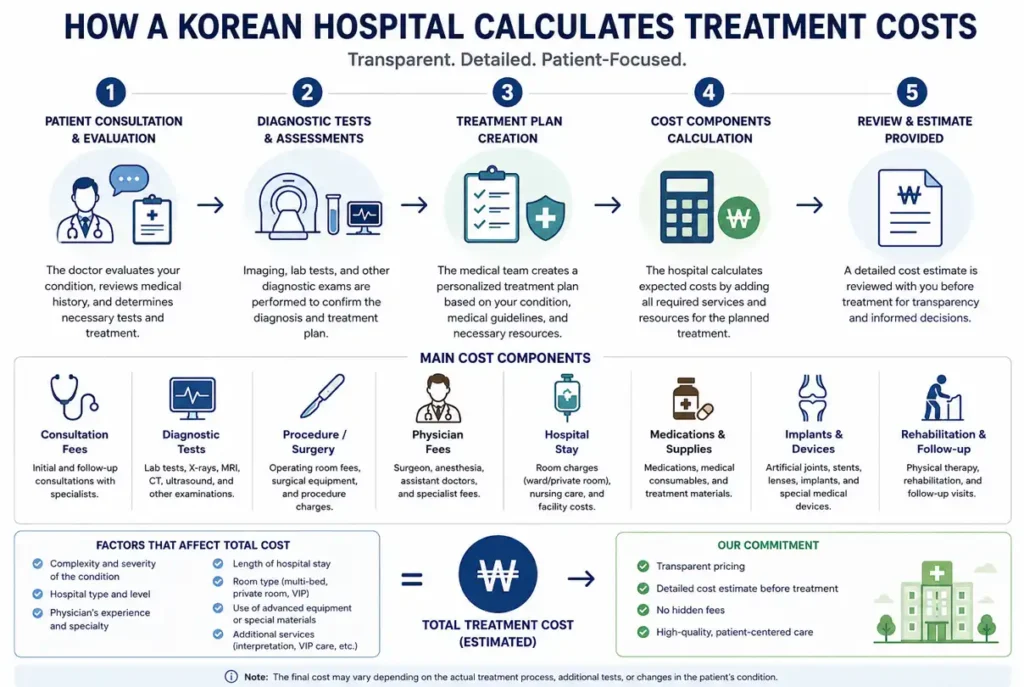
Understanding Hospital Pricing in Korea at a Glance
Hospital pricing in South Korea is generally more transparent and competitive than in many countries because healthcare fees are influenced by a combination of government regulation, market competition, hospital type, physician expertise, technology used, and whether a treatment is covered by Korea’s National Health Insurance (NHI). For international patients, prices vary depending on the hospital, medical condition, surgeon’s experience, room selection, and personalized treatment plans.
Unlike countries where hospital bills may contain unexpected charges after treatment, Korean hospitals typically provide a detailed cost estimate before major procedures. However, estimates may still change if additional diagnostic tests, medications, or unexpected medical interventions become necessary.
Why Hospital Prices Differ in Korea
Many international patients expect a single price for a medical procedure, but hospital pricing reflects multiple clinical and administrative factors.
Common variables include:
- Hospital classification
- Complexity of the medical condition
- Physician’s specialization
- Surgical difficulty
- Medical devices or implants used
- Length of hospitalization
- Required laboratory testing
- Anesthesia requirements
- Rehabilitation services
- Follow-up care
For example, two patients receiving knee replacement surgery may receive different estimates because one requires complex deformity correction while the other undergoes a routine procedure.
How Korea’s Healthcare System Influences Pricing
South Korea operates one of the world’s most efficient universal healthcare systems through the National Health Insurance (NHI).
For Korean residents covered by NHI, many medically necessary services are partially reimbursed.
International patients generally pay:
- Full self-pay rates
- International patient pricing
- Package pricing (for selected medical tourism services)
Cosmetic surgery, elective dermatology, and many wellness procedures are usually not covered by NHI for anyone.
Main Components of a Hospital Bill
Understanding what is included helps patients compare estimates accurately.
A hospital invoice may include:
| Cost Component | Description |
|---|---|
| Consultation | Initial specialist evaluation |
| Diagnostic imaging | MRI, CT, X-ray, ultrasound |
| Laboratory tests | Blood work, pathology |
| Procedure or surgery | Operating room fees |
| Physician fees | Surgeon and assistant physicians |
| Anesthesia | Medications and anesthesiologist |
| Hospital room | General ward or private room |
| Medications | During hospitalization |
| Medical devices | Implants, prosthetics, surgical materials |
| Rehabilitation | Physical therapy if required |
| Follow-up visits | Post-treatment monitoring |
Patients should always ask which services are included in the quoted estimate.
Types of Korean Hospitals
Hospital type significantly influences pricing.
University Hospitals
Examples include large academic medical centers.
Characteristics:
- Advanced technology
- Highly specialized physicians
- Complex surgeries
- Higher consultation fees
- Strong research environment
These hospitals often receive referrals for difficult or rare medical conditions.
General Hospitals
General hospitals offer comprehensive medical services while maintaining lower operating costs than many university hospitals.
Suitable for:
- Orthopedic surgery
- Internal medicine
- Gastroenterology
- Cardiology
- Cancer screening
Specialized Clinics
Many international patients visit specialized clinics for:
- Plastic surgery
- Dermatology
- Ophthalmology
- Dentistry
- Fertility treatment
Because these clinics focus on specific specialties, they often provide streamlined care with predictable package pricing.
Factors That Affect Treatment Costs

Physician Experience
Senior surgeons with decades of experience may charge more than junior specialists.
This reflects expertise rather than differences in basic hospital fees.
Technology Used
Hospitals investing in newer technologies often have higher procedure costs.
Examples include:
- Robotic-assisted surgery
- AI-assisted diagnostic imaging
- Advanced laser systems
- Navigation-assisted orthopedic surgery
- Premium intraocular lenses
These technologies may improve precision but also increase overall expenses.
Hospital Room Selection
Accommodation choices affect the final bill.
Options typically include:
- Multi-bed rooms
- Semi-private rooms
- Private rooms
- VIP suites
Private rooms provide greater comfort but increase hospitalization costs.
Medical Complexity
A standard operation usually costs less than a complicated revision surgery.
Examples include:
- Repeat spinal surgery
- Revision joint replacement
- Multi-level spinal fusion
- Advanced cancer surgery
Additional operating time and specialized equipment increase overall expenses.
Understanding Cost Estimates
Most Korean hospitals provide written estimates before treatment.
These estimates generally include:
- Expected procedure fees
- Hospital stay
- Operating room charges
- Physician fees
- Standard medications
However, estimates may exclude:
- Additional pathology tests
- Unexpected ICU admission
- Emergency procedures
- Extended hospitalization
- Treatment for unforeseen complications
Patients should request clarification regarding possible additional charges.
Insurance Considerations for International Patients
Coverage depends entirely on the patient’s insurance provider.
Some global insurance plans:
- Reimburse overseas treatment
- Require prior authorization
- Pay hospitals directly
- Require patients to submit reimbursement claims
Patients should verify:
- Coverage limits
- Excluded procedures
- Pre-approval requirements
- Required documentation
Comparing Prices Responsibly
Choosing the lowest price is not always the safest approach.
Patients should evaluate:
- Hospital accreditation
- Physician qualifications
- Annual procedure volume
- Infection control measures
- Patient safety systems
- Postoperative care
- Interpreter services
Quality and safety should remain primary decision-making factors.
Questions International Patients Should Ask
Before scheduling treatment, consider asking:
- What exactly is included in the estimate?
- Are surgeon fees separate?
- What additional costs could occur?
- How many follow-up visits are included?
- Are medications included?
- Does the estimate include implants?
- What happens if hospitalization is extended?
- Are interpreter services complimentary?
Obtaining written answers improves transparency.
Practical Example
Consider an international patient traveling to Korea for cataract surgery.
The initial estimate may include:
- Consultation
- Eye examination
- Surgery
- Standard intraocular lens
- Operating room
- Follow-up visit
If the patient later chooses a premium multifocal lens, the overall cost increases because the upgraded implant carries an additional fee.
This illustrates why two patients undergoing the same surgery may receive different quotations.
Advantages of Korea’s Pricing System
International patients often appreciate several characteristics of Korean healthcare pricing.
Benefits include:
- Transparent written estimates
- High-quality medical technology
- Efficient scheduling
- Competitive pricing compared with many developed countries
- Clearly itemized invoices
- Integrated international patient centers
These features contribute to Korea’s growing reputation as a global medical tourism destination.
Potential Hidden Costs to Consider
Even with transparent estimates, patients should budget for additional expenses outside medical treatment.
Examples include:
- Airfare
- Hotel accommodation
- Transportation
- Meals
- Visa expenses
- Translation services (if not provided)
- Caregiver assistance
- Travel insurance
A complete financial plan should include both medical and non-medical costs.
FAQ Section

Is hospital pricing regulated in Korea?
Many medically necessary services are influenced by Korea’s National Health Insurance fee schedule, while elective procedures, cosmetic treatments, and services for international self-pay patients have greater pricing flexibility.
Why do hospitals quote different prices for the same procedure?
Differences may result from surgeon expertise, hospital facilities, technology used, implants, anesthesia methods, hospitalization duration, and the complexity of the patient’s condition.
Are Korean hospitals transparent about pricing?
Most hospitals provide written cost estimates before major treatments. Patients should confirm whether the estimate includes consultations, diagnostics, medications, implants, follow-up care, and any potential additional charges.
Can international health insurance cover treatment in Korea?
Some international insurance providers reimburse overseas medical care or offer direct billing, but coverage varies by policy. Patients should verify benefits and obtain any required pre-authorizations before treatment.
Does choosing a cheaper hospital always save money?
Not necessarily. Lower upfront costs may not reflect the quality of care, physician experience, technology, or included services. Comparing value, safety, and outcomes is often more important than comparing price alone.
Key Takeaways
Understanding hospital pricing in Korea requires more than comparing headline costs. Prices are shaped by hospital type, physician expertise, treatment complexity, technology, room selection, and whether services are covered under Korea’s National Health Insurance or paid privately. While Korean hospitals are widely recognized for providing transparent estimates and advanced medical care, patients should review every quotation carefully, confirm what is included, and consider both medical quality and total travel-related expenses. By asking informed questions and comparing comprehensive treatment plans—not just prices—international patients can make confident healthcare decisions and better prepare for a safe, predictable medical journey in South Korea.
References
- Ministry of Health and Welfare (MOHW), Republic of Korea. Healthcare Policy and National Health Insurance System. https://www.mohw.go.kr/
- National Health Insurance Service (NHIS), Korea. National Health Insurance System Overview. https://www.nhis.or.kr/
- Health Insurance Review & Assessment Service (HIRA). Healthcare Costs and Medical Fee Information. https://www.hira.or.kr/
- Korea Health Industry Development Institute (KHIDI). Medical Korea: Guide for International Patients. https://www.khidi.or.kr/
- World Health Organization (WHO). Health System in the Republic of Korea. https://www.who.int/
- Organisation for Economic Co-operation and Development (OECD). Health at a Glance 2025: OECD Indicators. https://www.oecd.org/health/
- OECD. OECD Health Statistics Database. https://www.oecd.org/health/health-data.htm
- Joint Commission International (JCI). International Hospital Accreditation Standards. https://www.jointcommissioninternational.org/
- International Society for Quality in Health Care (ISQua). International Healthcare Quality Standards. https://isqua.org/
- Korean Statistical Information Service (KOSIS). National Health and Medical Statistics. https://kosis.kr/

Korea Med Tour – Trusted Blog for Medical Tourism in Korea
Korea Med Tour is a trusted medical tourism content platform providing accurate, research-based healthcare information for international patients considering treatment in Korea.
Our editorial team specializes in global patient guidance, treatment insights, clinic selection, and medical travel planning. All content is developed using verified medical sources and structured editorial review processes to ensure clarity, safety, and reliability.
We are committed to helping international patients make informed and confident medical travel decisions when choosing Korea as their healthcare destination.