
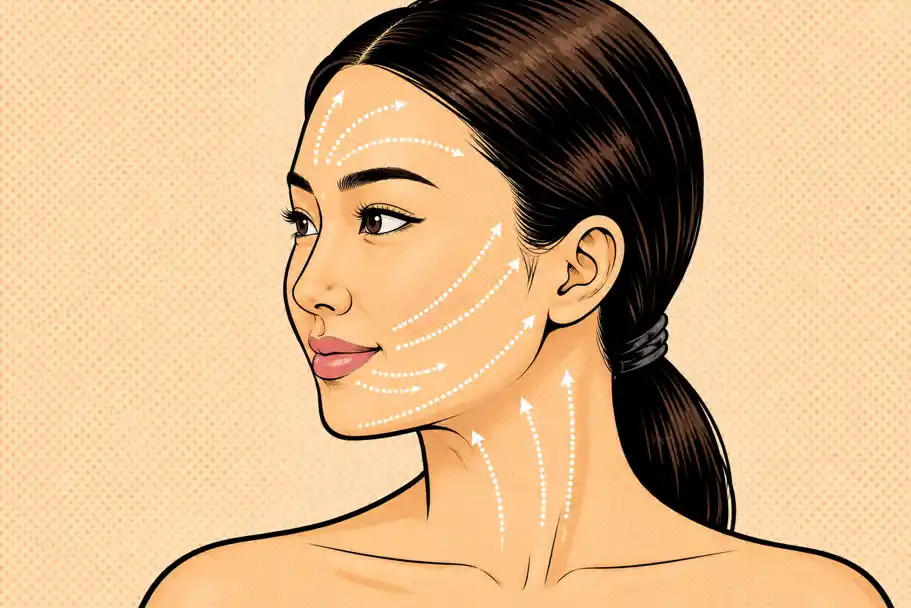

How much does facial contour lifting cost in Korea?
KoreaMedTour.com
Facial contour lifting in Korea typically costs ₩250,000 to ₩3,500,000+, depending on the treatment type, device, number of shots, treatment area, and clinic. HIFU and RF treatments generally cost less than premium lifting procedures such as Ultherapy or Thermage, while thread lifting and surgery require individualized pricing.
Quick Summary
There is no single standard price for facial contour lifting in Korea because treatment costs vary depending on the technology, treatment area, number of shots or threads, clinic, physician, treatment protocol, and whether VAT or additional services are included.
As a practical planning framework, international patients should calculate:
Total Facial Lifting Budget = Treatment Cost + Consultation + VAT/Additional Fees + Flights + Accommodation + Food & Transportation + Translation/Support + Contingency
For example, a patient choosing a basic HIFU or RF treatment may spend considerably less than someone undergoing a premium Ultherapy or Thermage treatment, while thread lifting may involve additional consultation, medication, and recovery-related costs.
A useful approach is to confirm three numbers before booking:
- Expected treatment cost — the estimated price for the recommended procedure, including the treatment area and shot count.
- Maximum planned budget — the amount you are prepared to spend if the physician recommends additional or complementary treatment.
- Total travel budget — the complete cost of the Korea trip, including flights, accommodation, transportation, meals, and support services.
The important point is that the cheapest facial lifting price in Korea is not necessarily the best value. Compare the treatment technology, number of shots, treatment area, physician consultation, expected results, recovery time, and total cost before making a decision.
Table of Contents

What Is Facial Contour Lifting?
Facial contour lifting refers to treatments designed to improve the appearance of facial sagging, skin laxity, jowls, a less-defined jawline, and age-related changes in facial contours.
As people age, facial shape can change because of several factors:
- Reduced skin elasticity
- Collagen and elastin loss
- Changes in facial fat compartments
- Soft-tissue descent
- Reduced structural support
- Gravity and cumulative sun exposure
A lifting treatment does not necessarily “remove” facial aging. Instead, different technologies target different layers of tissue to tighten skin, stimulate collagen remodeling, reposition tissue, or reduce localized fat.
The American Academy of Dermatology notes that non-invasive skin-tightening procedures generally produce more modest results than surgery, with results often developing gradually as collagen remodeling occurs.
How Much Does Facial Contour Lifting Cost in Korea?
There is no single national price for facial contour lifting because Korean clinics offer many different technologies and treatment protocols.
2026 indicative price ranges
| Treatment | Typical published range in Korea* | Main purpose |
|---|---|---|
| Korean HIFU / Shurink-type treatments | ₩250,000–₩900,000 | Skin tightening & lifting |
| InMode | ₩50,000–₩800,000 | Contouring, fat reduction & tightening |
| Oligio RF | ₩300,000–₩800,000 | RF tightening |
| Ultherapy / Ultherapy Prime | ₩1,200,000–₩2,700,000+ | Deeper lifting & tightening |
| Thermage FLX | ₩1,800,000–₩3,500,000+ | RF tightening & collagen remodeling |
| Thread lifting | ₩450,000–₩2,000,000+ | Mechanical lifting |
| Surgical facelift | Individual quotation | Significant tissue laxity |
*These are indicative published-market ranges, not guaranteed national prices. Actual prices depend on the clinic, treatment area, device, shot count, thread type and number, practitioner, promotions, VAT, and treatment plan. Current published Seoul pricing illustrates the wide variation: one clinic lists Ultherapy Prime from ₩300,000 to ₩2,700,000 and Thermage FLX from ₩1,000,000 to ₩2,600,000, while another lists Ultherapy Prime at ₩1,450,000 and Thermage FLX at ₩1,990,000.
Another Seoul dermatology clinic currently lists Ultherapy Prime at ₩550,000 for 100 shots, ₩2,000,000 for 400 shots and ₩3,000,000 for 600 shots, while Thermage FLX for the face is listed at ₩2,500,000 for 600 shots. The clinic notes that its listed prices exclude 10% VAT.
This demonstrates why price per treatment name is not enough. A ₩700,000 Ultherapy quotation and a ₩2,000,000 quotation may involve substantially different shot counts and treatment areas.
Why Are Facial Lifting Prices So Different?
One of the most common mistakes international patients make is comparing two prices without comparing what is actually included.
1. Treatment technology
HIFU, RF, RF microneedling, laser-based treatments, thread lifting and surgery work differently.
For example:
Ultrasound lifting uses focused ultrasound energy to heat targeted tissue. The FDA-cleared Ulthera System is indicated for non-invasive lifting of the eyebrow and lax submental and neck tissue, among other indications.
Radiofrequency treatments use electromagnetic energy to heat tissue and encourage collagen remodeling.
Thread lifting places absorbable threads beneath the skin to provide mechanical support while tissue healing occurs around the threads.
Facelift surgery involves surgical repositioning of facial and/or neck tissues and is fundamentally different from non-surgical lifting.
2. Number of shots
For device-based treatments, shot count can have a major effect on the price.
For example, a 100-shot treatment is not equivalent to a 400- or 600-shot treatment.
This is particularly important with ultrasound and RF devices because clinics may advertise the treatment name prominently while displaying a low entry price for a smaller treatment protocol.
When comparing clinics, ask:
How many shots are included in the quoted price?
Also ask which facial areas will be treated.
3. Treatment area
“Full face” can mean different things at different clinics.
A quotation may include:
- Cheeks
- Lower face
- Jawline
- Double chin
- Neck
- Forehead
- Around the eyes
A treatment limited to the lower face may cost considerably less than a full-face-and-neck protocol.
Which Facial Lifting Treatment Is Used for Which Concern?
Choosing a treatment should begin with the problem being treated, not the machine name.
Mild skin laxity
Patients with early signs of aging may be candidates for non-invasive ultrasound or RF treatments.
These treatments generally aim to produce gradual tightening rather than a surgical-level change.
The AAD reports that ultrasound tightening may produce modest lifting and tightening that develops over approximately 2–6 months, while RF treatments can also take time as collagen production occurs.
Jawline definition
If the primary concern is a soft or poorly defined jawline, the clinician should determine whether the cause is:
- Skin laxity
- Submental fat
- Facial fat distribution
- Muscle anatomy
- Loss of structural volume
- Combination of these factors
This distinction matters because a skin-tightening procedure cannot necessarily correct every cause of a less-defined jawline.
Jowls
Mild jowling may sometimes be addressed with energy-based tightening.
However, significant tissue descent may require a different treatment strategy. A facelift is designed to address visible signs of aging such as midface sagging, lower-face skin laxity and jowls.
Double chin
When excess submental fat is a major component, a clinician may consider a contouring approach rather than relying exclusively on skin tightening.
The AAD notes that non-invasive fat-reduction techniques vary by technology and may require multiple treatment sessions.
Non-Surgical vs. Thread vs. Surgical Lifting
Understanding the three broad categories can make Korean clinic pricing much easier to interpret.
1. Non-invasive lifting
Examples include:
- HIFU
- Ultherapy
- RF treatments
- Thermage
- Other ultrasound or energy-based devices
There is no surgical incision, and downtime is generally limited compared with surgery.
The trade-off is that results are usually more subtle than those achieved with surgical lifting. The AAD specifically distinguishes non-invasive tightening from surgical procedures, noting that surgical lifting generally provides the most dramatic correction of significant sagging.
2. Thread lifting
Thread lifting is minimally invasive.
It can provide a more immediate mechanical lifting effect than many energy-based treatments, but swelling, bruising and other procedure-specific risks need to be considered.
The final result also depends on the thread material, design, number of threads and treatment technique.
3. Facelift surgery
A facelift is a surgical procedure intended to improve visible facial and neck aging.
It can address more substantial tissue laxity than non-surgical treatments, but it also involves surgical risks and recovery.
The American Society of Plastic Surgeons lists potential facelift complications including bleeding, infection, nerve injury, prolonged swelling, changes in sensation, poor wound healing, scarring and asymmetry.
What Should International Patients Ask a Korean Clinic?
For overseas patients, the written treatment quotation is particularly important.
Before making a reservation, ask the clinic:
Treatment details
- What exact device will be used?
- Is the device an original manufacturer system?
- How many shots are included?
- Which areas will be treated?
- Is the neck included?
- Who performs the treatment?
- Is a doctor consultation included?
Price details
- Is the quoted price for one session?
- Does the price include VAT?
- Are consultation or anesthesia fees additional?
- Are medications included?
- Are there additional treatment fees after consultation?
- Is the advertised price a promotional price for new patients?
These questions can prevent a common problem: choosing a clinic based on an attractive advertised price and discovering that the actual recommended treatment has a substantially different cost.
How to Compare Korean Facial Lifting Clinics
Instead of asking only:
“How much is facial lifting?”
use a more specific comparison:
“What treatment, what device, how many shots, which areas, who performs it, and what is the total price including VAT?”
For example:
Clinic A
Ultherapy Prime — ₩800,000
100 shots
Clinic B
Ultherapy Prime — ₩1,800,000
400 shots
The second quotation is not automatically “more expensive” in a meaningful comparison. The treatment volume is different.
This is why price-per-shot or price-per-treatment area can sometimes be more useful than the headline treatment price.
Is Cheap Facial Lifting in Korea Better?
Price alone should not be used as the main measure of treatment quality.
A very low advertised price may reflect:
- A smaller treatment area
- Fewer shots
- A promotional campaign
- A different device
- A lower treatment intensity
- A basic rather than customized protocol
- VAT being excluded
Korea has a formal system for reporting and publishing non-covered medical expenses. Under the 2026 rules, the Ministry of Health and Welfare’s framework covers reporting and public disclosure of non-covered medical treatment prices, and HIRA provides a service where patients can check hospital-specific non-covered prices.
HIRA also states that its non-covered medical expense information allows consumers to compare prices between medical institutions and view average costs.
However, a published price should still be treated as a reference point rather than a personalized treatment quotation.
What Results Can You Realistically Expect?
The expected result depends heavily on the degree of laxity.
Early aging
A patient with relatively mild laxity may notice:
- A slightly sharper jawline
- Improved skin firmness
- Reduced appearance of mild sagging
- Gradual improvement in skin texture
Moderate laxity
More than one modality may sometimes be considered, depending on the patient’s anatomy and treatment objectives.
Significant laxity
Non-invasive lifting may not provide the degree of correction a patient expects.
This is one of the most important points for international patients: a non-surgical lifting procedure should not be marketed as equivalent to a facelift.
The AAD similarly notes that non-invasive tightening produces more modest results than surgical lifting.
How Long Do Facial Lifting Results Last?
There is no universal duration.
Results depend on:
- Age
- Skin quality
- Degree of laxity
- Sun exposure
- Smoking
- Weight changes
- Treatment technology
- Energy settings
- Number of treatments
- Individual collagen response
Non-invasive procedures can produce gradual results rather than an immediate permanent change. The AAD notes that RF and ultrasound treatments stimulate collagen-related remodeling and that maintenance treatments may benefit some patients.
Therefore, a clinic should avoid promising that one treatment will permanently stop facial aging.
Are Facial Contour Lifting Treatments Safe?
Most cosmetic procedures have potential side effects, even when minimally invasive.
Common short-term effects of energy-based treatments may include:
- Redness
- Swelling
- Tenderness
- Temporary discomfort
More invasive treatments can have additional risks.
RF microneedling deserves particular attention. In 2025, the American Academy of Dermatology issued a statement concerning an FDA safety communication about potential risks associated with certain uses of RF microneedling and emphasized the importance of appropriate medical expertise.
For surgical facelift procedures, potential complications are more extensive and can include infection, bleeding, nerve injury, poor wound healing and prolonged swelling.
A proper consultation should therefore include a discussion of indications, expected results, alternatives and risks rather than focusing exclusively on price. The AAD specifically recommends obtaining this information during a cosmetic-treatment consultation.
Facial Contour Lifting in Korea: A Practical Budget Guide
For international patients planning a trip to Seoul, a practical preliminary budget might look like this:
Entry-level lifting:
Approximately ₩250,000–₩900,000
Premium energy-based lifting:
Approximately ₩1,200,000–₩3,500,000+
Thread lifting:
Approximately ₩450,000–₩2,000,000+
Surgical facial lifting:
Usually requires an individualized consultation and quotation.
These figures are intended for initial planning, not as guaranteed treatment prices. Current clinic menus demonstrate substantial variation even for the same branded technology.
How to Choose the Right Facial Contour Lifting Clinic in Korea
A good clinic comparison should evaluate at least five factors:
1. Medical assessment
Does the clinician determine whether your concern is caused primarily by skin laxity, fat, volume loss, muscle activity or tissue descent?
2. Appropriate technology
Is the selected treatment appropriate for the anatomical problem?
3. Transparent pricing
Does the clinic clearly state treatment areas, shot count, VAT and additional costs?
4. Medical supervision
Is the procedure performed or supervised by an appropriately trained medical professional?
5. Realistic expectations
Does the clinic explain both what the procedure can and cannot achieve?
These factors are more useful than simply selecting the lowest advertised price.
FAQ Section

How much does facial contour lifting cost in Korea?
The facial contour lifting cost in Korea generally ranges from ₩250,000 to ₩3,500,000+, depending on the technology, treatment area, number of shots, and clinic. HIFU and RF treatments are generally more affordable, while premium treatments such as Ultherapy and Thermage can cost more.
What is the average facial lifting Korea price?
The facial lifting Korea price varies by treatment. Basic HIFU or RF treatments may start at several hundred thousand won, while premium ultrasound or RF lifting can cost over ₩1 million. Always compare the number of shots and areas treated rather than the advertised price alone.
How do I choose a facial contour lifting clinic in Korea?
When choosing a facial contour lifting clinic in Korea, consider the treatment technology, physician consultation, treatment plan, shot count, treatment area, total price, and experience treating international patients. A proper assessment should determine whether your concern is primarily skin laxity, facial fat, or tissue descent.
What is the difference between non-surgical face lifting and thread lifting in Korea?
Non-surgical face lifting in Korea commonly uses ultrasound or radiofrequency energy to stimulate tissue tightening and collagen remodeling. Thread lifting uses absorbable threads placed under the skin to provide mechanical support. The appropriate option depends on the degree and cause of facial laxity.
Is facial contour lifting in Korea worth the cost for international patients?
The value of facial contour lifting in Korea depends on the treatment selected and the patient’s individual goals. Non-surgical treatments can provide gradual tightening with relatively limited downtime, while thread or surgical procedures may provide more substantial lifting but involve greater recovery and risks.
Final Takeaway
Facial contour lifting in Korea can cost anywhere from several hundred thousand won to several million won in 2026, but the treatment name alone does not tell you whether two prices are comparable.
The most important variables are:
Treatment technology → treatment area → shot/thread count → practitioner → protocol → VAT/additional fees → expected outcome.
For mild to moderate skin laxity, non-invasive ultrasound and RF procedures may provide gradual tightening with relatively limited downtime. More significant tissue laxity may require minimally invasive or surgical approaches. The AAD and ASPS both emphasize that non-surgical procedures should not be considered equivalent to surgical facelift procedures in terms of the degree of correction they can achieve.
For international patients considering treatment in Seoul, the safest approach is to obtain a written, itemized quotation after a medical consultation, rather than choosing a clinic solely from an advertised price.
2026 price information should also be rechecked before booking, because Korean non-covered treatment prices, promotions and clinic protocols can change.
References
- Korean Law Information Center — Korean regulations concerning the reporting and disclosure of non-covered medical expenses.
Korean Law Information Center - American Academy of Dermatology (AAD) — Non-invasive skin tightening, expected results, treatment considerations, and safety.
AAD — Skin Tightening - D&A Dermatology Clinic– Facial Contour Lifting Clinic

Korea Med Tour – Trusted Blog for Medical Tourism in Korea
Korea Med Tour is a trusted medical tourism content platform providing accurate, research-based healthcare information for international patients considering treatment in Korea.
Our editorial team specializes in global patient guidance, treatment insights, clinic selection, and medical travel planning. All content is developed using verified medical sources and structured editorial review processes to ensure clarity, safety, and reliability.
We are committed to helping international patients make informed and confident medical travel decisions when choosing Korea as their healthcare destination.