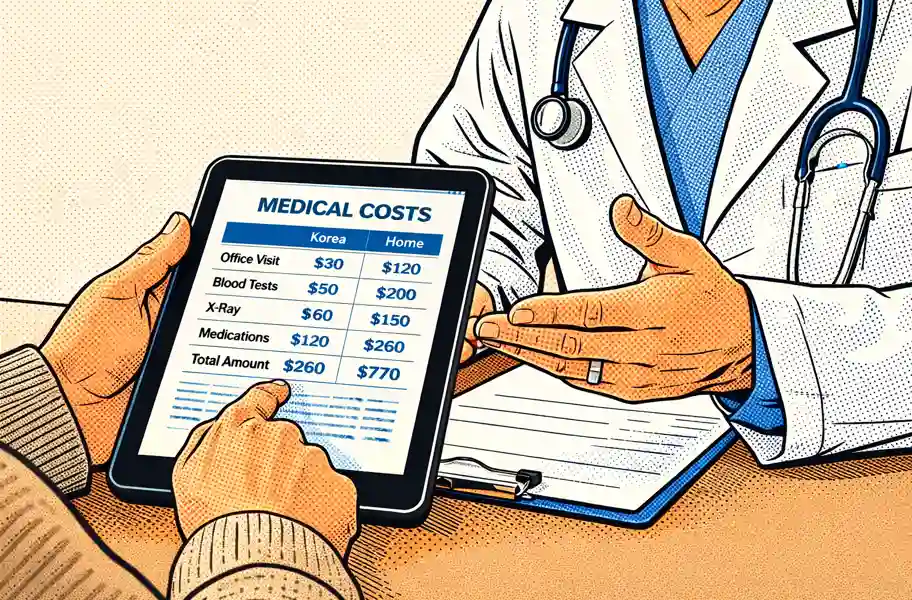


How much does refractive surgery cost in Seoul, Korea?
KoreaMedTour.com
Refractive surgery in Seoul, Korea, typically costs ₩1,000,000–₩8,500,000 for both eyes in 2026, depending on the procedure. LASIK and LASEK are generally more affordable, while SMILE Pro and EVO ICL cost more. Final prices depend on eye condition, technology, examinations, and postoperative care.
Quick Summary
There is no single standard price for refractive surgery in Seoul, Korea, in 2026, because treatment costs vary depending on the ophthalmology clinic, surgical technique, laser technology, ophthalmologist’s experience, individual eye condition, preoperative examination results, and whether medications and postoperative care are included.
As a practical 2026 planning guide, international patients can use the following estimated Korean clinic pricing ranges to compare LASIK, LASEK, SMILE LASIK, SMILE Pro, and EVO ICL procedures.
Typical Refractive Surgery Cost in Seoul: ₩1,000,000–₩8,500,000 for both eyes, depending on the procedure and treatment package.
Typical LASIK Surgery Cost in Korea: ₩1,500,000–₩4,000,000 for both eyes.
Typical SMILE LASIK Cost in Seoul: ₩2,200,000–₩5,500,000 for both eyes.
Typical EVO ICL Surgery Cost in Korea: ₩4,500,000–₩8,500,000 for both eyes.
Common procedures and related expenses may include:
- LASEK / PRK Surgery: ₩1,090,000–₩2,800,000 for both eyes.
- Conventional LASIK Surgery: ₩1,500,000–₩4,000,000 for both eyes.
- SMILE LASIK Surgery: ₩2,200,000–₩5,500,000 for both eyes.
- SMILE Pro Surgery: ₩4,100,000–₩6,500,000 for both eyes.
- EVO ICL Surgery: ₩4,500,000–₩8,500,000 for both eyes.
- Comprehensive Preoperative Eye Examination: Varies depending on the clinic and diagnostic examination package.
- Prescription Eye Drops and Medications: Varies depending on the prescribed treatment.
- Additional Consultations and Follow-Up Care: Varies by clinic and treatment package.
- Postoperative Examinations: Included in some treatment packages; additional fees may apply.
- Accommodation in Korea: Varies depending on location, hotel category, and length of stay.
- Flights, Transportation, and Other Travel Expenses: Vary depending on the patient’s country of departure and travel arrangements.
The prices above are indicative planning ranges, not verified nationwide average prices across all Korean eye clinics. In particular, patients should confirm whether the quotation covers both eyes or one eye, and whether it includes diagnostic examinations, surgical fees, medications, and postoperative appointments. Actual costs may differ according to the patient’s prescription, corneal condition, selected technology, and treatment requirements.
Before booking, confirm whether the quoted price covers the complete treatment package, including the specific laser platform, surgeon’s fees, diagnostic examinations, medications, postoperative appointments, and any applicable additional fees. International patients should also confirm whether the clinic provides English-language consultations and assistance with postoperative care in Korea.
A useful approach is to confirm three numbers before booking:
- Expected Treatment Cost — The exact refractive surgery procedure, surgical fees for both eyes, required examinations, medications, and postoperative follow-up schedule.
- Maximum Treatment Budget — The amount you are prepared to spend if additional consultations, diagnostic examinations, alternative procedures, or medically necessary follow-up treatments are required.
- Total Korea Medical Tourism Budget — Flights, accommodation, transportation, meals, translation or international-patient support, and other travel expenses. Allow sufficient time for the clinic’s recommended postoperative examinations before returning home.
The important point is that the cheapest eye clinic in Korea is not necessarily the best value. Before choosing a provider, compare the operating ophthalmologist’s qualifications, surgical technique, laser technology, eligibility requirements, potential side effects, expected recovery time, and postoperative care arrangements.
It is also important to understand the differences between refractive surgery procedures. LASIK and LASEK reshape the cornea using laser technology, while SMILE uses a small incision to remove a precisely created corneal lenticule. SMILE Pro uses an advanced laser platform to perform the procedure. EVO ICL, in contrast, corrects refractive errors by implanting a specialized lens inside the eye without removing corneal tissue.
Each procedure has different eligibility requirements and recovery characteristics. LASIK generally offers relatively rapid visual recovery, while LASEK usually requires a longer initial healing period. SMILE provides a flap-free approach, whereas EVO ICL may be considered for selected patients with high myopia or corneal characteristics that make laser correction less suitable.
For international patients, recovery and follow-up planning are just as important as the advertised price. Temporary blurred vision, dry eyes, light sensitivity, glare, and fluctuating vision may occur following surgery. Visual recovery varies according to the procedure and individual eye condition. No procedure can guarantee perfect vision or complete independence from glasses.
For international patients, the most cost-effective approach is to obtain a written treatment plan and transparent quotation from a qualified ophthalmology clinic before booking flights or accommodation. This helps ensure that the selected procedure is clinically appropriate, the total treatment cost is understood, and sufficient time is available for postoperative examinations and recovery.
Table of Contents

How Much Does Refractive Surgery Cost in Seoul in 2026?
The following comparison uses publicly available Seoul clinic prices and an independent collection of published Korean ophthalmology fees updated in October 2026. All prices are indicative and generally refer to both eyes.
| Procedure | Estimated cost (KRW) | Approximate cost (USD) |
|---|---|---|
| LASEK / PRK | ₩1,090,000–₩2,800,000 | $730–$1,870 |
| Conventional LASIK | ₩1,500,000–₩4,000,000 | $1,000–$2,670 |
| SMILE LASIK | ₩2,200,000–₩5,500,000 | $1,470–$3,670 |
| SMILE Pro | ₩4,100,000–₩6,500,000 | $2,730–$4,330 |
| EVO ICL | ₩4,500,000–₩8,500,000 | $3,000–$5,670 |
USD conversions are illustrative, using approximately ₩1,500 per US dollar. Actual exchange rates and payment charges will differ. The ranges are not guaranteed quotations.
Understanding the differences in pricing
An independent October 2026 review of publicly advertised prices from Seoul ophthalmology clinics reported the following median prices:
| Procedure | Promotional median | Regular-price median |
|---|---|---|
| LASEK | ₩1,090,000 | ₩1,500,000 |
| LASIK | ₩1,655,000 | ₩2,150,000 |
| SMILE LASIK | ₩2,200,000 | ₩3,175,000 |
| SMILE Pro | ₩4,100,000 | ₩5,000,000 |
| ICL | ₩4,700,000 | ₩5,500,000 |
These figures are particularly useful for understanding the difference between promotional advertising and standard clinic pricing. The underlying dataset covers clinics that publicly disclosed their prices, rather than every ophthalmology clinic in Seoul. Diagnostic examination fees may be additional.
Important: A promotional price should not be considered the final treatment cost until the clinic confirms the procedure, both-eye coverage, examination fees, medications, and follow-up arrangements.
What Are the Different Types of Refractive Surgery?
Refractive surgery corrects vision by changing how light focuses on the retina. The appropriate procedure depends on the patient’s eye anatomy and prescription.
The five major options available in Seoul are LASIK, LASEK, SMILE, SMILE Pro, and implantable collamer lens surgery.
1. LASIK (Laser-Assisted In Situ Keratomileusis)
LASIK is a widely established refractive surgery that uses a laser to reshape the cornea and correct myopia, hyperopia, and astigmatism within suitable treatment ranges.
The surgeon creates a thin corneal flap, lifts it, and uses an excimer laser to reshape the underlying corneal tissue. The flap is then repositioned.
Estimated cost in Seoul: ₩1,500,000–₩4,000,000 for both eyes.
Advantages
- Relatively rapid visual recovery.
- Usually less postoperative discomfort than surface ablation.
- Many patients return to routine activities within a short period.
- Effective for appropriately selected patients.
Considerations
- Creates a permanent corneal flap.
- May aggravate existing dry-eye symptoms.
- Not suitable for certain patients with thin or irregular corneas.
- Contact sports and activities involving eye trauma require additional consideration.
LASIK may be appropriate for patients with stable prescriptions, healthy corneal measurements, and sufficient corneal thickness.
2. LASEK and PRK (Surface Ablation)
LASEK and PRK are surface-based laser procedures. Unlike LASIK, they do not create a permanent corneal flap.
The surgeon removes or separates the corneal surface epithelial layer and reshapes the underlying corneal tissue using an excimer laser. The epithelium subsequently regenerates during healing.
Estimated cost in Seoul: ₩1,090,000–₩2,800,000 for both eyes.
Advantages
- No LASIK-style corneal flap.
- Can be considered for some patients with relatively thin corneas.
- Useful for certain patients whose occupations or activities involve eye-trauma exposure.
Considerations
- More postoperative discomfort during initial healing.
- Visual recovery is generally slower than LASIK.
- Several days may be needed before functional vision improves substantially.
- Temporary or prolonged corneal haze can occur.
- Postoperative medication and monitoring are important.
LASEK and PRK are not automatically safer for every thin-cornea patient. Corneal shape, residual stromal tissue, prescription strength, and ectasia risk must still be assessed.
3. SMILE LASIK (Small Incision Lenticule Extraction)
SMILE is a minimally invasive laser vision correction procedure that uses a femtosecond laser to create a small disc of corneal tissue called a lenticule.
The surgeon removes this lenticule through a small incision, changing the corneal shape and correcting refractive errors.
Unlike conventional LASIK, SMILE does not require creation of a large corneal flap.
Estimated cost in Seoul: ₩2,200,000–₩5,500,000 for both eyes.
Advantages
- Small corneal incision.
- No conventional LASIK flap.
- Generally rapid functional visual recovery.
- May have advantages regarding certain postoperative dry-eye measures compared with LASIK.
Considerations
- Not every prescription or corneal condition is suitable.
- Visual recovery and refractive predictability depend on individual circumstances.
- Enhancement options differ from conventional LASIK.
- Surgeon experience with the technology and procedure is important.
SMILE is particularly relevant to patients with myopia and suitable astigmatism who want a flap-free laser procedure.
4. SMILE Pro
SMILE Pro is an advanced version of the SMILE procedure performed using the ZEISS VisuMax 800 femtosecond laser platform.
Its principal technological distinction is faster laser treatment and an updated treatment workflow. However, faster laser delivery does not automatically mean better long-term visual outcomes for every patient.
Estimated cost in Seoul: ₩4,100,000–₩6,500,000 for both eyes.
Advantages
- Faster laser treatment phase.
- Small-incision, flap-free surgical approach.
- Advanced laser platform and treatment workflow.
- Attractive for patients seeking newer refractive surgery technology.
Considerations
- Higher treatment cost.
- Not necessarily clinically superior to conventional SMILE for every patient.
- Eligibility depends on corneal measurements and prescription.
- Surgeon expertise and postoperative follow-up remain essential.
Patients should ask whether the quoted procedure is conventional SMILE or SMILE Pro, which laser platform is used, and what measurable benefits are expected in their individual case.
5. EVO ICL (Implantable Collamer Lens)
EVO ICL is different from laser-based refractive surgery. Instead of reshaping the cornea, the surgeon implants a biocompatible collamer lens inside the eye, generally behind the iris and in front of the natural crystalline lens.
The procedure is often considered for patients with high myopia or those whose corneal characteristics make laser correction less appropriate.
Estimated cost in Seoul: ₩4,500,000–₩8,500,000 for both eyes.
Advantages
- Does not remove corneal tissue.
- Can correct substantial degrees of myopia within approved lens ranges.
- The implanted lens can generally be removed or exchanged surgically if clinically necessary.
- May be an option for selected patients with relatively thin corneas.
Considerations
- It is an intraocular surgical procedure.
- Requires appropriate anterior chamber depth and other anatomical measurements.
- Potential complications include increased intraocular pressure, cataract formation, inflammation, and infection.
- Long-term monitoring is necessary.
ICL should not be considered a risk-free or permanently reversible alternative to laser surgery. Removing an implanted lens does not necessarily reverse every potential complication.
What Factors Affect Refractive Surgery Prices in Seoul?
Two patients visiting the same clinic may receive different quotations. The final cost depends on several medical and technical factors.
1. Laser technology and equipment
Different procedures require different surgical platforms.
For example:
- Conventional LASIK uses a flap-creation method and an excimer laser.
- SMILE uses a femtosecond laser to create a removable lenticule.
- SMILE Pro uses the newer VisuMax 800 platform.
- Customized surface ablation may involve additional diagnostic mapping and treatment planning.
Newer technology can increase the cost, but equipment specifications alone do not establish superior clinical outcomes.
2. Degree of myopia and astigmatism
Patients with higher prescriptions may require more extensive correction.
The surgeon must evaluate:
- Spherical prescription.
- Cylinder (astigmatism).
- Corneal thickness.
- Corneal curvature.
- Estimated remaining corneal tissue after treatment.
Not every high-myopia patient requires a premium procedure. In some cases, an alternative such as ICL may be more appropriate.
3. Preoperative diagnostic examinations
A comprehensive examination is essential before surgery. It helps identify conditions that could increase the risk of complications.
Common examinations include:
| Examination | Purpose |
|---|---|
| Refraction test | Measures myopia, hyperopia, and astigmatism |
| Corneal topography | Evaluates corneal curvature |
| Corneal tomography | Assesses corneal shape and possible abnormalities |
| Pachymetry | Measures corneal thickness |
| Tear-film evaluation | Identifies dry-eye problems |
| Pupil measurement | Assesses pupil size in different lighting conditions |
| Intraocular pressure | Screens for elevated eye pressure |
| Retinal examination | Evaluates the back of the eye |
| Endothelial cell count | Particularly relevant for ICL assessment |
A clinic should explain which tests are included in its advertised package and whether additional diagnostic services are charged separately.
4. Surgeon experience and postoperative care
Surgical fees may also reflect the surgeon’s experience, the clinic’s treatment protocols, diagnostic infrastructure, and follow-up services.
Patients should assess more than the number of procedures performed. Relevant questions include:
- Does the operating ophthalmologist personally review the diagnostic findings?
- How frequently does the surgeon perform the proposed procedure?
- What is the clinic’s protocol for managing complications?
- Are postoperative examinations included?
- Is enhancement treatment available if clinically indicated?
- Who provides follow-up care after the patient returns home?
A comprehensive treatment package should prioritize medical accountability rather than simply offering the lowest advertised price.
Who Is a Suitable Candidate for Refractive Surgery?
Refractive surgery is not appropriate for everyone. A successful outcome depends on selecting patients whose eyes can safely tolerate the proposed procedure.
General candidacy considerations include:
- Being at least 18 years old, with age and prescription stability considered individually.
- Having a relatively stable prescription, commonly for at least one year.
- Having healthy corneal tissue and appropriate corneal measurements.
- Having no untreated significant eye disease.
- Having realistic expectations about postoperative vision.
Patients with keratoconus, severe dry eye, unstable prescriptions, uncontrolled glaucoma, or certain corneal abnormalities may not be suitable for LASIK.
The American Academy of Ophthalmology identifies corneal health, prescription stability, and overall eye health as important factors in determining eligibility.
Which procedure may suit different patients?
| Patient consideration | Procedure to discuss |
|---|---|
| Healthy cornea and suitable prescription | LASIK or SMILE |
| Preference to avoid a corneal flap | SMILE or PRK |
| Relatively thin cornea | PRK/LASEK assessment |
| High myopia | EVO ICL assessment |
| Contact sports or high eye-trauma exposure | PRK or SMILE assessment |
| Significant dry eye | Treat ocular surface first; reassess options |
| Unstable prescription | Usually postpone surgery |
This table is a starting point for discussion, not a treatment recommendation. For example, thin corneas do not automatically make someone eligible for PRK, and high myopia does not automatically mean ICL is appropriate.
Is Refractive Surgery Safe? Understanding the Risks
Modern refractive procedures can provide substantial improvements in unaided vision, but no procedure guarantees perfect eyesight or freedom from glasses throughout life.
Patients should understand the following possible complications.
Dry eye syndrome
Temporary dry-eye symptoms are common after some refractive procedures, particularly LASIK. Symptoms may include:
- Burning or stinging.
- A gritty sensation.
- Fluctuating vision.
- Eye fatigue.
- Increased sensitivity to light.
Some patients experience prolonged or severe dry eye requiring ongoing treatment.
Glare, halos, and night-vision problems
Patients may notice halos around streetlights, glare from headlights, starbursts, or reduced visual quality in dim environments.
These symptoms often improve during recovery, but they can persist in some patients.
Undercorrection or overcorrection
The achieved correction may differ from the intended prescription. Some patients may continue to need glasses or contact lenses, and selected patients may qualify for additional treatment.
Corneal ectasia
Corneal ectasia is an uncommon but potentially serious complication in which the cornea progressively weakens and changes shape. Appropriate screening for keratoconus and other corneal abnormalities is therefore essential.
ICL-specific complications
Because ICL involves placing a lens inside the eye, potential complications include elevated intraocular pressure, cataract development, inflammation, infection, and problems related to lens sizing or positioning.
The US FDA provides detailed information about refractive surgery complications, including visual disturbances, dry eye, and the possibility of losing some corrected visual acuity.
A useful safety principle: A responsible clinic should be willing to recommend against surgery when the expected benefits do not justify the risks.
What Is Included in the Total Cost of Eye Surgery in Seoul?
When comparing clinics, patients should request an itemized quotation rather than relying on the advertised surgical fee.
The total treatment expense may include the following:
| Cost component | What to confirm |
|---|---|
| Initial consultation | Whether consultation is free or chargeable |
| Comprehensive examination | Whether all diagnostic tests are included |
| Surgical procedure | Whether the fee covers both eyes |
| Surgeon fee | Whether the operating surgeon is specified |
| Medication | Antibiotic, anti-inflammatory, and lubricating drops |
| Protective equipment | Eye shields or protective eyewear, if required |
| Follow-up appointments | Number and duration of included visits |
| Additional treatment | Cost of clinically necessary enhancements |
| Translation support | Whether medical interpretation is included |
| Medical documentation | Availability of English-language records |
For international patients, accommodation, transportation, meals, and additional travel days should also be included in the overall budget.
Example: Estimated total budget for an international patient
Consider a patient traveling to Seoul for SMILE surgery.
| Expense | Illustrative budget |
|---|---|
| SMILE surgery, both eyes | ₩3,000,000 |
| Additional examination allowance | ₩100,000 |
| Medication allowance | ₩50,000 |
| Accommodation, 5 nights | ₩500,000 |
| Transportation and meals | ₩200,000 |
| Estimated total | ₩3,850,000 |
Illustrative financial scenario, not a clinic quotation. Some clinics include examination and medication fees in their surgical packages. Accommodation and living expenses depend on the patient’s choices.
This example demonstrates why the cheapest advertised surgical package may not represent the lowest overall cost of medical travel.
How Long Should International Patients Stay in Seoul?
International patients should plan their trip around the procedure’s recovery requirements and the clinic’s postoperative examination schedule.
A practical itinerary may look like this:
Example 5–7 day treatment itinerary
- Day 1 – Arrival and consultationArrive in Seoul, attend the initial consultation, and confirm the examination schedule.
- Day 2 – Comprehensive eye examinationComplete diagnostic testing and receive a personalized surgical recommendation.
- Day 3 – SurgeryUndergo the approved procedure and receive postoperative instructions.
- Day 4 – Early postoperative examinationAttend the scheduled examination and review recovery progress.
- Days 5–7 – Recovery and departure assessmentAttend any additional required checks and obtain medical clearance and follow-up instructions for travel.
This is an example itinerary, not a universal medical schedule. LASEK/PRK often requires more recovery time than LASIK or SMILE. ICL patients also require appropriate postoperative pressure and lens-position monitoring.
Patients should not book a non-refundable return flight before receiving advice from their operating surgeon.
Can you fly after LASIK, LASEK, or SMILE?
Flying is not automatically prohibited after refractive surgery. However, the appropriate departure date depends on the procedure, healing progress, and postoperative examination findings.
International patients should ask their surgeon:
- When is the first postoperative examination?
- How many examinations are needed before departure?
- Is additional monitoring required after returning home?
- What should they do if pain, redness, or sudden visual deterioration occurs during travel?
For more information, see our guide to Flying After SMILE LASIK or LASEK, which explains the importance of postoperative recovery and travel planning.
How to Choose the Right Eye Clinic in Seoul

Seoul has numerous ophthalmology clinics offering refractive surgery. However, patients should evaluate clinical standards, diagnostic quality, and postoperative support before comparing prices.
The following checklist can help patients make a more informed decision.
1. Verify the surgeon’s qualifications
Confirm that the procedure is performed by a qualified ophthalmologist with relevant refractive surgery experience.
Ask about:
- Medical qualifications and ophthalmology specialization.
- Experience with the specific procedure.
- Experience treating patients with similar prescriptions.
- Complication management and enhancement protocols.
2. Check the diagnostic equipment
A comprehensive preoperative examination should include corneal mapping, thickness measurements, refractive assessment, and ocular surface evaluation.
For ICL, additional measurements of anterior chamber anatomy and other relevant structures are important.
3. Compare the actual procedure, not just the advertised price
A clinic advertising a low-cost SMILE package may offer different equipment, diagnostic services, or postoperative arrangements from another clinic.
Ask whether the procedure includes:
- The latest applicable laser platform.
- Customized treatment planning.
- Both eyes.
- Postoperative medications.
- Scheduled follow-up examinations.
4. Confirm international patient support
International patients should check whether the clinic provides:
- English-speaking medical coordinators.
- Professional medical interpretation.
- English medical records.
- Assistance with postoperative communication.
- Clear instructions for obtaining medical attention after returning home.
5. Understand long-term follow-up
Refractive surgery does not eliminate the need for regular eye examinations.
Patients should retain their preoperative measurements, surgical records, and postoperative reports. These records can be useful for future ophthalmological care, including cataract evaluation.
Why Consider Seoul, South Korea for Refractive Surgery?
Seoul is an established destination for ophthalmology and medical services, with clinics offering a range of refractive surgery technologies.
Several factors attract international patients.
1. Access to multiple surgical technologies
Patients can consult ophthalmologists about LASIK, LASEK, SMILE, SMILE Pro, and ICL without limiting their evaluation to a single procedure.
2. Advanced diagnostic infrastructure
Many specialist clinics offer comprehensive diagnostic testing, including corneal tomography, optical measurements, and advanced laser-based examinations.
3. Competitive pricing
Publicly advertised Korean prices provide international patients with several treatment options across different budget levels.
4. Established medical tourism infrastructure
Seoul has international patient coordination services, multilingual medical support, and accommodation options suitable for overseas visitors.
5. Convenient access to follow-up examinations
Patients staying in Seoul can arrange early postoperative examinations before returning home, subject to their surgeon’s recommendations.
Nevertheless, medical tourism requires careful planning. International patients should prioritize continuity of care over convenience or promotional discounts.
FAQ Section

How much does refractive surgery cost in Seoul, Korea, in 2026?
Refractive surgery costs in Seoul, Korea, generally range from ₩1,000,000 to ₩8,500,000 for both eyes. LASEK and conventional LASIK are usually more affordable, while SMILE Pro and EVO ICL typically cost more. The final price depends on the surgical method, diagnostic examinations, laser technology, and postoperative care.
How much does SMILE LASIK cost in Seoul, South Korea?
SMILE LASIK in Seoul typically costs approximately ₩2,200,000–₩5,500,000 for both eyes. SMILE Pro may cost ₩4,100,000–₩6,500,000. Prices vary by clinic, laser platform, surgeon expertise, and treatment package. Patients should undergo a comprehensive eye examination before confirming the final surgical cost.
Is LASIK or LASEK cheaper in Korea?
LASIK and LASEK are generally more affordable than SMILE LASIK and EVO ICL in Korea. LASEK typically costs approximately ₩1,090,000–₩2,800,000, while conventional LASIK ranges from ₩1,500,000–₩4,000,000 for both eyes. The appropriate procedure depends on corneal thickness, prescription, and overall eye health.
How much does EVO ICL surgery cost in Seoul, Korea?
EVO ICL surgery in Seoul generally costs approximately ₩4,500,000–₩8,500,000 for both eyes. This procedure uses an implantable collamer lens rather than reshaping the cornea with a laser. It may be suitable for selected patients with high myopia or corneal characteristics that make laser vision correction less appropriate.
Can international patients receive affordable refractive surgery in Seoul, Korea?
Yes. International patients can access LASIK, LASEK, SMILE, SMILE Pro, and EVO ICL procedures at ophthalmology clinics in Seoul. Many clinics provide international patient coordination and multilingual assistance. Patients should compare complete treatment packages, confirm postoperative examinations, and arrange sufficient recovery time before returning home.
Final Thoughts: Finding the Right Balance Between Cost and Clinical Quality
Refractive surgery costs in Seoul in 2026 vary according to the treatment method, laser platform, surgeon’s experience, and postoperative care.
For patients comparing options, LASEK and conventional LASIK generally represent more affordable choices. SMILE and SMILE Pro offer alternative flap-free laser procedures, while EVO ICL provides a different approach for appropriately selected patients, particularly those with higher degrees of myopia.
However, the best treatment is not necessarily the cheapest or most technologically advanced option.
A comprehensive eye examination should determine whether the cornea can safely undergo laser correction, whether an implantable lens is appropriate, and what visual outcome can realistically be expected.
For international patients, the most important considerations are medical suitability, transparent pricing, qualified ophthalmologists, reliable postoperative monitoring, and access to follow-up care after returning home.
The objective should be to achieve the best clinically appropriate visual outcome while minimizing avoidable surgical risks.
Resources
- National Eye Institute – Surgery for Refractive Errors
- US FDA – LASIK Risks and Choosing a Surgeon
- BSM Eye Care Clinic Refractive Surgery

Korea Med Tour – Trusted Blog for Medical Tourism in Korea
Korea Med Tour is a trusted medical tourism content platform providing accurate, research-based healthcare information for international patients considering treatment in Korea.
Our editorial team specializes in global patient guidance, treatment insights, clinic selection, and medical travel planning. All content is developed using verified medical sources and structured editorial review processes to ensure clarity, safety, and reliability.
We are committed to helping international patients make informed and confident medical travel decisions when choosing Korea as their healthcare destination.