


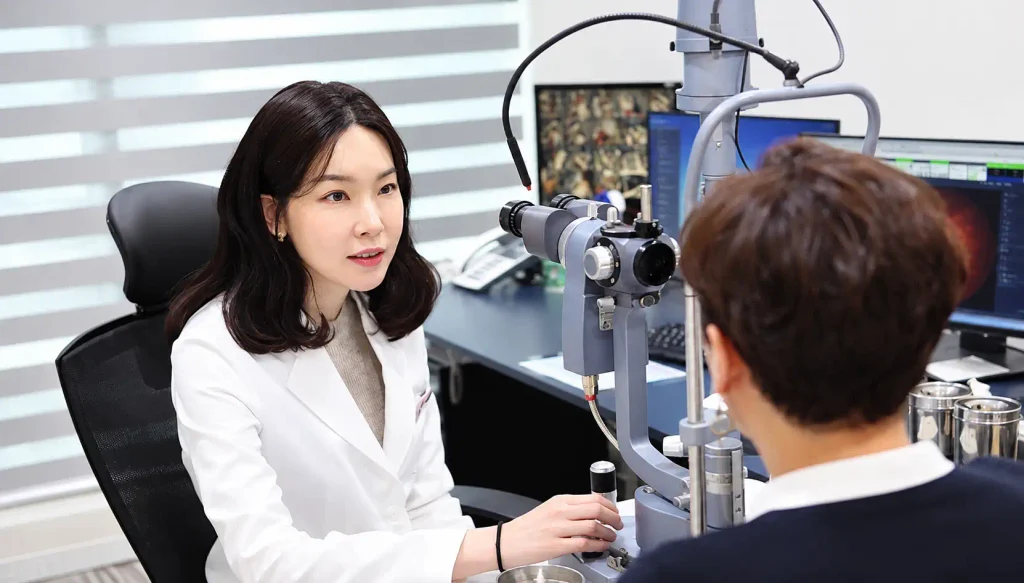
Dr. Ji-Eun Geum is the Chief Director of Gangnam Bright St. Mary’s Eye Clinic in Korea. Her personalized approach to eye surgery in Korea focuses on vision correction and comprehensive eye care, with treatment plans tailored to each patient’s eye condition, visual needs, and treatment goals.
KoreaMedTour.com
This exclusive KoreaMedTour interview features Dr. Ji-Eun Geum, Chief Director of Gangnam Bright St. Mary’s Eye Clinic in Korea, discussing personalized vision correction, eye surgery options, comprehensive eye care, and treatment planning tailored to each patient’s visual needs and eye condition.
For international patients considering eye surgery in Korea, choosing an ophthalmologist involves more than comparing procedure prices or available technologies. Understanding a physician’s clinical approach, assessment of eye health, treatment recommendations, and commitment to patient safety is equally important.
In this exclusive KoreaMedTour interview, Dr. Ji-Eun Geum discusses her approach to personalized vision correction and eye care, explaining the importance of evaluating each patient’s eye condition, visual needs, and treatment goals before determining an appropriate treatment plan.
Her approach emphasizes individualized assessment, careful treatment selection, and helping patients make informed decisions about eye surgery and ophthalmic care in Korea.
Her guiding principle is:
“Personalized Vision Correction. Comprehensive Eye Care. Patient-Centered Treatment.”
Table of Contents
Meet Dr. Ji-Eun Geum
Dr. Ji-Eun Geum is the Chief Director of Gangnam Bright St. Mary’s Eye Clinic in Korea and an ophthalmologist specializing in corneal care and vision correction.
Throughout her clinical practice, Dr. Geum has focused on helping patients achieve comfortable vision while preserving corneal health. Her clinical interests include LASIK, LASEK, SMILE, ICL implantation, presbyopia, cataract treatment, and the management of dry eye.
Her treatment philosophy emphasizes comprehensive eye examinations before selecting a procedure. By evaluating corneal thickness and shape, prescription stability, astigmatism, pupil size, dry eye, and retinal health, she aims to recommend treatment options suited to each patient’s eye condition, lifestyle, and visual needs.
Dr. Geum also emphasizes that not every patient is a suitable candidate for vision correction surgery. She believes that explaining examination results, discussing realistic expectations, and recommending against surgery when necessary are essential parts of responsible ophthalmic care.
For international patients, she highlights the importance of preparing eye examination records in advance and planning postoperative follow-up, including care after returning home. Her approach prioritizes informed decision-making, patient safety, and long-term visual comfort over choosing a procedure based solely on popularity or cost.
Her guiding principle is to treat each patient’s eyes as she would those of a member of her own family.
Q1. What Inspired You to Become an Ophthalmologist?
Dr. Ji-Eun Geum:
I did not begin my medical career with a grand sense of mission. As a student, I was fascinated by the eye. It is such a small structure, yet much of the information through which we experience the world passes through it.
I also appreciated that ophthalmology is a field in which both examination findings and treatment outcomes can often be observed directly. Rather than simply hearing that a patient feels somewhat better, you can hear them say, “I can see.” I found that particularly rewarding.
My interest in the cornea and vision correction became stronger during my clinical training. I saw patients whose vision had deteriorated because of corneal problems regain the ability to read after treatment. These experiences showed me how profoundly such a small structure can affect a person’s daily life.
I see refractive surgery as an extension of that work. It is about helping people with healthy eyes see more comfortably, with outcomes that can make a meaningful difference in their everyday lives.
Q2. What Is Your Philosophy of Patient Care?
Dr. Ji-Eun Geum:
I follow one guiding principle: “What would I do if this patient were a member of my own family?”
I apply that principle whether I am recommending surgery or advising against it.
I also want patients to understand their own eye conditions before making a decision. I spend time reviewing examination results with them and explaining why a particular procedure may be appropriate and why another option may be better avoided.
The eye is an organ in which some changes are difficult to reverse once surgery has been performed. I believe it is perfectly acceptable to take a little more time before making an important decision.
Choosing not to undergo surgery can also be a valid outcome of a medical consultation.
Q3. What Are Your Main Clinical Interests in Corneal Care and Vision Correction?
Dr. Ji-Eun Geum:
My main interest is finding ways to correct vision safely while disturbing the cornea as little as possible.
Vision correction surgery involves working with the cornea, and once corneal tissue has been removed, it does not grow back to its original thickness. Accurately assessing corneal thickness and shape is therefore the starting point for surgical safety.
I am particularly interested in determining how techniques that extract a small lenticule from within the cornea, as well as procedures such as ICL implantation, can be applied to appropriate patients while reducing the amount of corneal tissue removed.
Another important area is maintaining the health of the corneal surface and tear film after surgery.
I do not consider an improvement in visual acuity alone to be the definition of success. Patients should also feel comfortable with their eyes after the procedure.
Q4. What Should Patients Check Before Vision Correction Surgery?
Dr. Ji-Eun Geum:
Before choosing a procedure, patients should first determine whether their eyes are suitable for surgery.
Important factors include corneal thickness and shape, whether their refractive prescription is stable, the severity of dry eye symptoms, intraocular pressure, and retinal health.
These factors can only be properly assessed through a comprehensive eye examination.
Questions about which procedure is currently popular or how much it costs should come afterward.
Many patients arrive at a consultation having already decided which procedure they want. However, their preferences sometimes change after they see their examination results. I consider this a natural and important part of the decision-making process.
Q5. How Do You Choose the Right Vision Correction Procedure for Each Patient?
Dr. Ji-Eun Geum:
The first thing I assess is the cornea. I look not only at its thickness but also at whether its shape is regular on corneal topography and whether sufficient tissue will remain after surgery.
If an adequate safety margin cannot be maintained, I will not perform that procedure, even if all the other conditions appear favorable.
Next, I consider the patient’s refractive prescription, degree of astigmatism, pupil size, and dry eye condition.
Lifestyle is also important. I ask whether the patient exercises frequently, works in an occupation involving physical contact, spends long hours in front of a computer, or is approaching the age when presbyopia may become a concern.
When more than one procedure is medically suitable, I recommend the option that best fits the patient’s daily life.
The decision should not be based on one or two measurements alone. It requires a comprehensive assessment of the eyes, the patient’s circumstances, and the potential risks and benefits.
Q6. How Has SMILE LASIK Technology Evolved?
Dr. Ji-Eun Geum:
The basic principle remains the same. A thin piece of tissue called a lenticule is created inside the cornea and removed through a small incision.
What has changed is the precision of laser equipment, the energy delivered to the tissue, the size of the incision, the accuracy of astigmatism correction, and the level of customization available for individual patients.
My advice to patients is that the name of a laser device does not guarantee a particular outcome.
There are three important questions to ask:
- Can the procedure performed with this device actually be used for my particular eye condition?
- Does the surgeon have sufficient experience using this equipment?
- Are the clinical outcomes of the technology supported by published data?
A technology being new does not automatically mean it is suitable for your eyes.
Q7. What Are Smart NOVA Pro and NOVA SMILE, and What Should Patients Expect?
Dr. Ji-Eun Geum:
I focus on three technical considerations when evaluating newer vision correction technologies.
First, whether improvements in lenticule creation precision can reduce the impact on corneal tissue. Second, whether astigmatism correction has become more accurate. Third, whether the results can be verified through actual clinical data.
This is also why clinical findings should be published in scientific journals. I want treatment claims to be supported by measurable results rather than simply by statements that a technology is effective.
From the patient’s perspective, the potential direction of these developments is more precise vision correction with an emphasis on preserving corneal tissue and reducing the burden associated with dry eye.
However, no technology is necessarily better for every patient. Its suitability depends on the individual’s eye condition and whether the procedure is appropriate for that particular case.
A comprehensive examination must come first.
Q8. Who May Consider Today’s LASEK?
Dr. Ji-Eun Geum:
Today’s LASEK is a type of surface-based laser vision correction that focuses on improving the recovery process.
Because it does not require the creation of a corneal flap, it may be considered for patients with limited corneal thickness, people whose occupations or activities involve frequent physical contact, and those who find it difficult to accommodate a prolonged recovery period.
Before surgery, I carefully evaluate the corneal epithelium, the severity of dry eye, corneal shape, and the patient’s refractive prescription.
There is also an important point that I explain honestly to patients: even when a procedure is designed with faster recovery in mind, LASEK requires time for the corneal epithelium to heal.
Patients should expect some discomfort during the initial recovery period, and it can take longer for their vision to stabilize completely.
Understanding these limitations before surgery helps patients develop realistic expectations and make better-informed decisions.
Q9. How Do LASIK, LASEK, SMILE, and ICL Differ?
Dr. Ji-Eun Geum:
Each procedure has a different approach, and the most appropriate option depends on the patient’s eye condition.
LASIK involves creating a corneal flap and reshaping the tissue underneath. Recovery is generally fast, but sufficient corneal thickness is necessary.
LASEK corrects the surface of the cornea without creating a flap. It may be an option for some patients with thinner corneas, although recovery is slower and initial discomfort can occur.
SMILE involves creating and removing a lenticule through a small incision. It can help preserve corneal structure and may have a lower dry eye burden for some patients, but the range of suitable refractive prescriptions can be limited.
ICL (implantable collamer lens) surgery corrects vision by placing a lens inside the eye without removing corneal tissue. It may be considered for some patients with high myopia or thin corneas, but it is an intraocular procedure and has its own risks and examination requirements.
When comparing these options, patients should consider five factors:
- How much corneal tissue is preserved
- The expected recovery period
- The potential impact on dry eye symptoms
- Whether the procedure can be reversed or the implanted lens removed
- The follow-up care required after surgery
Evaluating these factors alongside individual examination results and lifestyle needs can help narrow down the appropriate options.
Q10. Who May Be Suitable for ICL Implantable Contact Lens Surgery?
Dr. Ji-Eun Geum:
ICL surgery may be a good option for some patients with high myopia, thin or irregular corneas, significant dry eye symptoms, or concerns about removing corneal tissue.
Because the procedure preserves the cornea, the implanted lens can also be removed if medically necessary.
However, ICL surgery involves placing a lens inside the eye, making the preoperative examination particularly important.
I assess whether the anterior chamber is deep enough, whether the corneal endothelial cell count is adequate, and whether the internal dimensions of the eye allow the appropriate lens size to be selected.
An incorrectly sized lens can affect intraocular pressure or the natural lens. These measurements therefore need to be performed carefully.
The natural lens, retina, and intraocular pressure must also be evaluated. Regular postoperative examinations are essential.
Q11. Why Are Preoperative Eye Examinations Important?
Dr. Ji-Eun Geum:
I pay particular attention to corneal topography and corneal tomography.
One of the most important tasks is identifying signs of corneal weakness, including findings that may suggest keratoconus.
I also assess corneal thickness, accurate refractive measurements taken after an adequate break from contact lens use, pupil size, tear film condition, intraocular pressure, optic nerve health, and the retina.
It is quite common for examination results to change the originally planned procedure.
For example, a patient who initially wants LASIK may be advised to consider LASEK or SMILE because the cornea is too thin for the planned procedure. Another patient may be advised to consider ICL if the corneal condition makes laser correction less suitable.
If keratoconus is suspected, surgery may need to be postponed while the condition is monitored.
I see these changes in treatment recommendations as evidence that the examination process is doing its job.
Q12. When Should Vision Correction Surgery Be Avoided or Delayed?
Dr. Ji-Eun Geum:
Certain conditions require particular caution before vision correction surgery.
These include keratoconus or other corneal diseases, an unstable refractive prescription, pregnancy or breastfeeding, severe dry eye, and uncontrolled diabetes or autoimmune disease.
For example, patients who are still growing or whose prescription has changed significantly within the past year may need to postpone surgery until their refractive condition is stable.
If a patient has cataracts, glaucoma, or retinal disease, treatment of the underlying condition may need to take priority.
Expectations also matter. If a patient’s expectations of the surgical outcome differ significantly from what is realistically achievable, I believe it is important to address those differences during consultation.
If surgery is not appropriate, I will not recommend it.
Deciding against surgery is also a medical decision.
Q13. How Can Patients Distinguish Presbyopia from Cataracts?
Dr. Ji-Eun Geum:
Presbyopia occurs when the natural lens gradually loses its flexibility, making it more difficult to focus on nearby objects.
It commonly begins in the early to mid-40s. People may notice that distant objects remain relatively clear while reading small text on a phone becomes difficult, leading them to hold the phone farther away.
Cataracts are different. They occur when the natural lens becomes cloudy.
Patients may experience blurred vision at both near and far distances, increased glare, changes in vision depending on lighting conditions, or limited improvement even after changing their glasses.
If it is difficult to distinguish between the two conditions, an eye examination is the most reliable way to determine the cause.
I generally recommend an eye examination every one to two years for people over 40.
However, if vision changes suddenly, one eye becomes noticeably blurry, or glare becomes severe, patients should seek an eye examination promptly rather than waiting for a routine appointment.
Q14. How Is Treatment Personalized for Presbyopia and Cataracts?
Dr. Ji-Eun Geum:
The first question I ask is: “At what distance does this person need to see most clearly throughout the day?”
I consider whether the patient drives frequently, reads books or uses a phone for extended periods, works at a computer, or often drives at night.
Different intraocular lenses have distinct advantages and limitations, so selecting a lens that matches the patient’s lifestyle is essential.
I then assess the condition of the eyes, including corneal astigmatism, the suitability of the macula and retina for multifocal lenses, and the presence of dry eye.
I also make sure patients understand the differences between lens options.
Multifocal lenses can reduce dependence on glasses, but some patients may need time to adapt to visual effects such as halos or glare.
Monofocal lenses can provide clear vision at a selected distance, but glasses may still be needed for other distances.
Patients are more likely to make informed decisions when they understand these trade-offs before surgery.
Q15. How Does Dry Eye Affect Vision Correction Surgery?
Dr. Ji-Eun Geum:
Before surgery, I assess both the quantity and quality of the tear film, as well as the condition of the meibomian glands.
If dry eye is present, the general principle is to treat it first and improve the ocular surface before proceeding with surgery.
For patients with more severe symptoms, I may consider a procedure that has less impact on the corneal nerves or discuss ICL as an alternative, depending on the overall examination findings.
Ignoring dry eye can lead to a disappointing experience, even when visual acuity improves, because the eyes may remain uncomfortable.
After surgery, patients should use artificial tears consistently as prescribed.
Warm compresses and eyelid hygiene may also help. When using screens for long periods, consciously blinking, taking breaks, and maintaining appropriate indoor humidity can support eye comfort.
Dry eye symptoms often improve over time, but managing the recovery period carefully is important.
Q16. What Matters in Postoperative Care and Long-Term Eye Health?
Dr. Ji-Eun Geum:
Immediately after surgery, patients should follow five basic precautions:
- Use prescribed eye drops according to the recommended schedule.
- Avoid rubbing the eyes.
- Prevent water and cosmetics from entering the eyes during the early recovery period.
- Protect the eyes from ultraviolet exposure.
- Attend follow-up examinations on the scheduled dates.
Following these instructions helps patients navigate the postoperative period more safely.
For long-term eye health, it is important to remember that vision correction surgery does not permanently protect the eyes from future conditions.
Presbyopia and cataracts can still develop as people age. I recommend an eye examination once a year to monitor eye health over time.
There is also an important consideration after LASIK and LASEK: intraocular pressure measurements may read lower than the actual pressure following these procedures.
Patients should therefore tell their ophthalmologist about their previous vision correction surgery during future examinations.
Q17. How Do You Prioritize Patient Safety Throughout Vision Correction Surgery?
Dr. Ji-Eun Geum:
During the examination stage, the most important task is identifying eyes that should not undergo surgery. I do not apply relaxed eligibility criteria.
When planning a procedure, I take a conservative approach that aims to preserve an adequate amount of corneal tissue.
Even if removing a little more tissue might appear to offer a visual advantage, maintaining a sufficient safety margin comes first.
During surgery, I emphasize consistent equipment checks, adherence to standardized procedures, and having the physician who conducted the consultation perform the surgery.
After surgery, an effective follow-up system is essential so that potential problems can be identified early and patients can contact the medical team promptly.
Surgery may take only one day, but patients live with their eyes for the rest of their lives.
Q18. What Should International Patients Prepare Before Receiving Eye Treatment in Korea?
Dr. Ji-Eun Geum:
One of the most useful things international patients can provide is their previous eye examination records from their home country.
These may include:
- Their current glasses prescription
- Changes in their refractive prescription over the past one to two years
- Previous corneal topography results, if available
- A history of previous eye surgery or ophthalmic conditions
- Information about existing medical conditions and current medications
Sending these records before traveling to Korea can help us make a preliminary assessment of which procedures may be worth considering and plan the consultation more efficiently.
Contact lens use also needs to be managed before the examination.
For accurate measurements, patients should generally stop wearing soft contact lenses for at least one week. Hard contact lenses may require a substantially longer break, depending on the type of lens and the individual circumstances.
Patients should plan their stay in Korea to include the initial examination, surgery if appropriate, and the first postoperative assessment. The required duration varies according to the procedure, so the schedule should be confirmed during consultation.
I also recommend identifying an ophthalmologist in the patient’s home country who can provide follow-up care after the patient returns home.
Q19. What Questions Do International Patients Ask Most Often?
Dr. Ji-Eun Geum:
International patients frequently ask:
- Is the procedure safe?
- How many days do I need to stay in Korea?
- What happens if I experience a problem after returning home?
- Which procedure is most suitable for my eyes?
- How much does the treatment cost?
These are all reasonable questions.
There are two points I would particularly like patients to understand.
First, examination results should determine which procedure is appropriate. Rather than arriving with a decision based solely on a procedure they have seen online, patients can receive more accurate guidance by sending their existing examination records in advance.
Second, even a relatively short visit can be planned more effectively when the necessary steps are arranged ahead of time.
However, treatment does not end when the patient leaves Korea. Follow-up care after returning home is also an important part of the treatment process.
Our clinic also places importance on maintaining communication with patients after they return to their home countries.
Q20. What Is Your Final Message to Patients Considering Vision Correction or Cataract Surgery?
Dr. Ji-Eun Geum:
The goal is not simply to stop wearing glasses. It is to see comfortably for years to come.
From that perspective, there is no need to rush into surgery. Take the time to understand your examination results, ask all the questions you have, and make a decision when you feel confident that you understand the options.
I also hope patients will not feel disappointed if they are told that surgery is not suitable for them.
That recommendation may mean the doctor has carefully evaluated their eyes and determined that surgery would not be the right choice.
Wherever you receive treatment, I encourage you to find an ophthalmologist who reviews your examination results with you and explains the reasoning behind the recommendations.
FAQ Section

Who is Dr. Ji-Eun Geum?
Dr. Ji-Eun Geum is the Chief Director of Gangnam Bright St. Mary’s Eye Clinic in Korea. She focuses on personalized vision correction and ophthalmic care, including LASIK, LASEK, SMILE, ICL implantation, presbyopia, cataracts, and dry eye management.
How does Dr. Geum determine which vision correction procedure is suitable for each patient?
Dr. Geum evaluates factors such as corneal thickness and shape, prescription stability, astigmatism, pupil size, dry eye, and retinal health. She also considers each patient’s lifestyle and visual needs to help determine whether LASIK, LASEK, SMILE, ICL, or another approach may be appropriate.
What is the difference between LASIK, LASEK, SMILE, and ICL surgery in Korea?
LASIK corrects vision beneath a corneal flap, while LASEK treats the corneal surface without creating a flap. SMILE removes a small piece of tissue from within the cornea through a small incision, whereas ICL involves placing a lens inside the eye without removing corneal tissue. Each procedure has different advantages, limitations, and recovery considerations, so suitability depends on individual examination results.
Can international patients receive eye surgery at Gangnam Bright St. Mary’s Eye Clinic in Korea?
International patients can prepare for a consultation by sharing their eye examination records, glasses prescription, recent prescription changes, previous eye surgery or disease history, and current medications. Dr. Geum explains that providing these details in advance can help the clinic make a preliminary assessment and plan the visit, including the examination, potential treatment, and postoperative review.
How does Dr. Geum prioritize safety and long-term eye health after vision correction surgery?
Dr. Geum emphasizes careful preoperative examinations, conservative treatment planning, and preserving sufficient corneal tissue. She believes surgery should not be recommended when a patient’s eyes are unsuitable. After treatment, patients should follow their prescribed eye-drop schedule, attend follow-up appointments, protect their eyes during recovery, and continue regular eye examinations to monitor long-term eye health.
Eye Surgery in Korea for International Patients
Dr. Ji-Eun Geum’s interview highlights an approach to vision correction and eye care that places each patient’s eye condition, visual needs, and long-term eye health at the center of treatment decisions.
For international patients, the process described in the interview includes several important stages:
Before Traveling to Korea
- Prepare recent eye examination records and a current glasses prescription
- Gather information about prescription changes over the past one to two years
- Provide previous corneal topography results, if available
- Review any history of eye disease, previous eye surgery, systemic conditions, and current medications
- Ask the clinic how long to stop wearing contact lenses before the examination
- Plan enough time for the consultation, potential surgery, and initial postoperative review
During the Visit to Korea
- Comprehensive eye examination and consultation with the ophthalmologist
- Assessment of corneal thickness, shape, and overall eye health
- Evaluation of prescription stability, astigmatism, pupil size, dry eye, intraocular pressure, and retinal health
- Discussion of suitable vision correction options, including LASIK, LASEK, SMILE, and ICL, where appropriate
- Explanation of potential benefits, limitations, recovery expectations, and possible risks
- Individualized treatment planning based on examination results, lifestyle, and visual needs
After Treatment
- Follow the prescribed eye-drop schedule and postoperative instructions
- Avoid rubbing the eyes and follow guidance on water exposure, cosmetics, and eye protection during early recovery
- Attend scheduled postoperative examinations
- Manage dry eye symptoms according to the ophthalmologist’s recommendations
- Arrange appropriate eye care after returning home
- Continue regular eye examinations to monitor long-term eye health
This approach reflects Dr. Geum’s view that eye surgery should be determined by comprehensive examination results rather than by the popularity, name, or price of a procedure.
Why Personalized Vision Correction Matters in Modern Ophthalmology
One of the recurring themes in Dr. Geum’s interview is the importance of determining whether a patient’s eyes are suitable for surgery before selecting a procedure.
Patients with similar prescriptions may have different corneal thicknesses, corneal shapes, tear film conditions, or other eye health considerations. These differences can influence which treatments may be appropriate and whether surgery should be postponed or avoided.
Her approach emphasizes considering:
- Corneal thickness, shape, and the amount of tissue that would remain after surgery
- Prescription stability and the degree of astigmatism
- Pupil size and dry eye severity
- Intraocular pressure, optic nerve condition, and retinal health
- Lifestyle factors, including work, exercise, and visual demands
- Potential effects on corneal tissue, recovery time, and postoperative comfort
- Realistic expectations and the need for follow-up care
Dr. Geum also emphasizes that newer technology is not automatically the most suitable option for every patient. The choice between LASIK, LASEK, SMILE, and ICL should depend on the individual’s examination results, treatment goals, and risk factors.
In some cases, another procedure may be more appropriate than the one a patient initially prefers. In other cases, the safest recommendation may be not to undergo surgery.
The objective is to identify a suitable treatment approach while prioritizing patient safety, informed decision-making, and long-term visual comfort.
From Vision Correction to Long-Term Eye Health
A central theme of Dr. Geum’s approach is that successful vision correction involves more than reducing dependence on glasses.
Patients also need to consider eye comfort, corneal health, dry eye symptoms, recovery, and the possibility of age-related eye conditions developing later.
For some patients, the priority may be correcting myopia or astigmatism. Others may need to consider presbyopia or cataract treatment. The appropriate approach depends on the condition being treated and the overall health of the eyes.
Dr. Geum also stresses the importance of managing dry eye before surgery when necessary and maintaining appropriate postoperative care. Even when visual acuity improves, persistent discomfort can affect a patient’s experience and satisfaction.
In this sense, ophthalmic care is not simply about selecting a surgical technique.
It involves understanding the eyes, evaluating the available options, explaining the relevant risks and limitations, and supporting eye health over time.
Meet the Doctor Behind the Treatment Philosophy
Dr. Ji-Eun Geum
Chief Director
Gangnam Bright St. Mary’s Eye Clinic, Korea
Primary areas discussed in this interview:
- LASIK vision correction
- LASEK vision correction
- SMILE vision correction
- ICL implantation
- Corneal assessment and care
- Dry eye management before and after surgery
- Presbyopia treatment
- Cataract treatment
- Individualized ophthalmic treatment planning
- Postoperative care and long-term eye health
Her approach emphasizes careful examination, appropriate procedure selection, clear communication, and balancing potential visual benefits with safety considerations.
A Message for International Patients
For patients considering eye surgery in Korea, the most important question may not simply be, “Which procedure is the most popular?”
It may be:
“Are my eyes suitable for surgery?”
“Which procedure best fits my eye condition and visual needs?”
“What are the potential benefits, risks, and limitations?”
“How much time should I allow for examination, treatment, and recovery?”
“How will my follow-up care be managed after I return home?”
Dr. Geum’s interview presents an approach built around these questions.
Rather than focusing solely on a procedure or technology, her approach connects comprehensive eye examinations, individualized treatment planning, realistic expectations, and long-term follow-up.
For international patients, this means considering the entire treatment journey—from preparing eye examination records before traveling to Korea to arranging postoperative care after returning home.
Careful Examination. Personalized Vision Correction. Long-Term Eye Health.
That is the central message Dr. Ji-Eun Geum shares with international patients through KoreaMedTour.
This interview is based on responses provided by Dr. Ji-Eun Geum, Chief Director of Gangnam Bright St. Mary’s Eye Clinic. Individual treatment suitability, expected outcomes, and potential risks should be discussed with a qualified ophthalmologist following a comprehensive eye examination.
References
- Dr. Ji-Eun Geum, Chief Director, Gangnam Bright St. Mary’s Eye Clinic — Exclusive Interview with KoreaMedTour.
- Gangnam Bright St. Mary’s Eye Clinic Global Website

Korea Med Tour – Trusted Blog for Medical Tourism in Korea
Korea Med Tour is a trusted medical tourism content platform providing accurate, research-based healthcare information for international patients considering treatment in Korea.
Our editorial team specializes in global patient guidance, treatment insights, clinic selection, and medical travel planning. All content is developed using verified medical sources and structured editorial review processes to ensure clarity, safety, and reliability.
We are committed to helping international patients make informed and confident medical travel decisions when choosing Korea as their healthcare destination.